

Dr. Egon Dejonckheere
Egon does research in Emotion, Clinical Psychology and Abnormal Psychology. His most recent publication is 'The Bipolarity of Affect and Depressive Symptoms', featured in Journal of Personality and Social Psychology: Personality Processes and Individual Differences.




What is ambulatory assessment
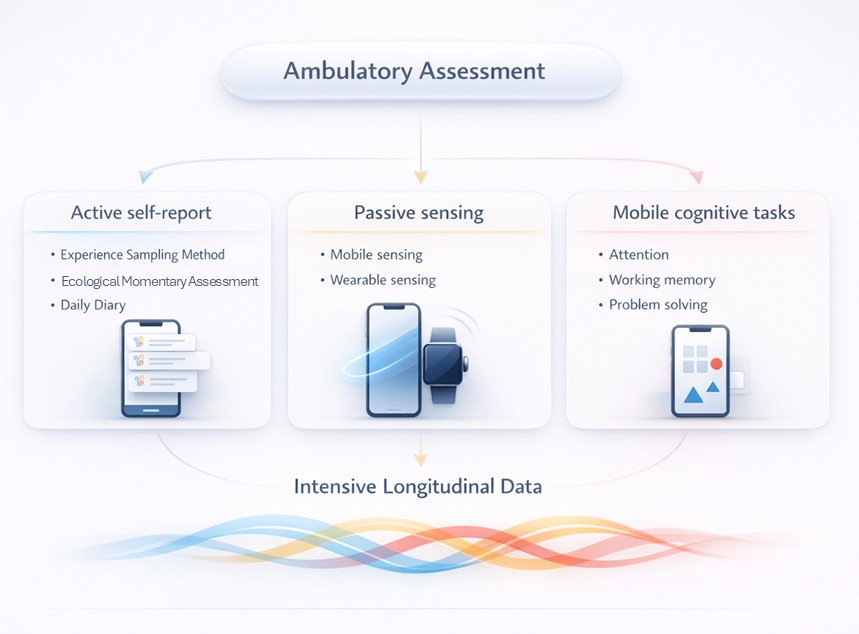
Specifically, the term serves as an umbrella concept that encompasses a range of data collection approaches used to study individuals in their daily contexts. These approaches include the Experience Sampling Method (ESM), Ecological Momentary Assessment (EMA), and daily diary studies, which typically involve repeated self-report surveys delivered throughout the day or once per day. In many modern studies, these self-reports are combined with mobile sensing (e.g., smartphone or wearable sensors that capture contextual or physiological signals) and mobile cognitive tasks that allow researchers to assess processes such as attention or memory under real-world conditions.
Across these different approaches, the core idea of ambulatory assessment is that behavioral, psychological, and physiological processes are dynamic and context-dependent. Emotions, thoughts, behaviors, symptoms, and cognitive functioning fluctuate across time and situations. To study these processes adequately, researchers therefore rely on repeated measurements collected during daily life rather than single, static assessments. These data streams are called intensive longitudinal data or time series data.
Why researchers use ambulatory assessment
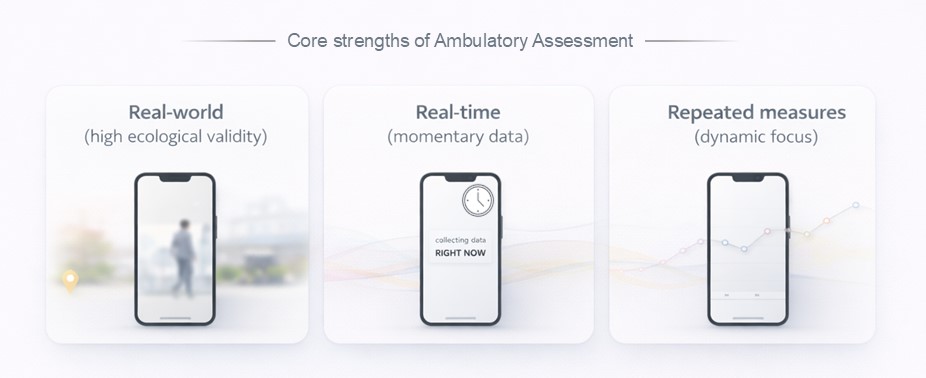
Compared to traditional research methods or data collection techniques (such as retrospective questionnaires or laboratory experiments), ambulatory assessment offers several distinct advantages. In particular, three key features are central to its growing use: high ecological validity, reduced retrospective bias, and the ability to study within-person dynamics.
Ecological validity: studying people in their natural habitat
This focus on natural contexts is important because many psychological phenomena are strongly shaped by situational factors. Emotions, stress responses, and symptoms often depend on the specific events, interactions, and environments people encounter throughout the day. Observing these processes within real-world contexts allows researchers to examine how psychological states vary across everyday situations and activities.
Ambulatory assessment therefore complements traditional laboratory experiments. While experimental studies remain essential for testing causal mechanisms through controlled manipulation, ambulatory assessment allows researchers to investigate how these mechanisms operate within the complexity of daily life, the context we ultimately want to understand and make claims about.
Reduced recall bias: capturing momentary experiences
Ambulatory assessment takes a different approach, and pursues real-time data collection. In the case of Ecological Momentary Assessment (EMA) or Experience Sampling Methodology (ESM), participants typically report on their current state or very recent experiences, often multiple times per day. Because the time between the experience and the report is short, these measurements rely less on long-term memory and more on immediate evaluation. This helps limit well-known recall biases, such as the tendency to overemphasize particularly intense experiences (e.g., peak-end rule biases) or the influence of current mood on how past experiences are remembered (e.g., mood-congruent effects).
Importantly, not all ambulatory measurements rely on self-report. Modern protocols increasingly combine momentary surveys with passive data streams from smartphones or wearable devices, as well as mobile cognitive tasks administered directly on participants’ devices. These measurement approaches do not depend on retrospective recall at all. Instead, they capture behavioral, physiological, or cognitive signalsdirectly as they occur. Together, these modalities allow ambulatory assessment studies to obtain measurements that are closely aligned with the timing of the underlying processes or constructs being studied.
Within-person dynamics: understanding how processes unfold over time
Ambulatory assessment addresses this limitation by collecting repeated measurements for each participant, often multiple times per day across several days or weeks. These intensive longitudinal data make it possible to examine how emotions, symptoms, thoughts, and behaviors fluctuate within individuals, and how these changes relate to events or contextual factors in daily life.
Importantly, within-person dynamics do not necessarily mirror between-person patterns. Associations observed at the group level may differ from, or even reverse within individuals, a phenomenon known as Simpson’s paradox. As a result, relying solely on between-person analyses can obscure or misrepresent the processes that operate within individuals. This within-person perspective allows researchers to investigate questions that cannot be addressed with single-time-point measurements. For example, researchers can examine how stress at one moment predicts mood later in the day, how symptoms evolve across daily routines, or how individuals respond to specific experiences in their environment. By capturing these temporal patterns, ambulatory assessment provides a framework for studying psychological processes as dynamic systems that unfold across time and context.
What methods are included in ambulatory assessment?
Self-report methods: ESM, EMA and daily diary
Sensor-based methods: mobile and wearable sensing
Mobile cognitive tests
How does an ambulatory assessment study work?
Define your research question and construct
Design the sampling protocol
Build and pilot the ambulatory protocol
Recruit and onboard participants
Collect data in daily life
Clean and analyze the data
Dr. Egon Dejonckheere
Egon Dejonckheere is an Assistant Professor at Tilburg University, affiliated with KU Leuven, specializing in ambulatory assessment and intensive longitudinal research. His work combines methodological innovation to improve these methods with applications in mental health and emotion dynamics, and includes dozens of smartphone-based studies in daily life.


FAQ
01.
Ambulatory assessment is an umbrella term for methods that measure psychological, behavioral, and physiological processes in real-world settings over time. It involves collecting time series data during daily life rather than relying on single, retrospective assessments.
02.
Ambulatory assessment includes approaches such as experience sampling methodology (ESM), ecological momentary assessment (EMA), and daily diary methods. It can also incorporate mobile sensing and wearable data to capture behavior and physiology, as well as cognitive tasks to assess momentary cognitive ability alongside self-report.
03.
Unlike traditional surveys or laboratory studies, ambulatory assessment collects data in real time and in natural environments. This allows researchers to study how processes unfold in daily life rather than relying on memory or artificial settings.
04.
Ambulatory assessment can capture data about awide range of topics, including emotions, thoughts, behaviors, symptoms, contextual factors, physiological signals, and cognitive performance. These data are often collected repeatedly to track changes over time.
05.
Key advantages include high ecological validity, reduced recall bias, and the ability to study within-person changes over time. These features allow researchers to better understand how experiences and behaviors fluctuate in real-world contexts.
06.
Ambulatory assessment is the broader framework, while Experience Sampling Methodology (ESM) and Ecological Momenatary Assessment (EMA) are specific methods within it. ESM and EMA focus primarily on repeated self-report, whereas ambulatory assessment can also include passive sensing and other measurement approaches.