

Dr. Egon Dejonckheere
Egon does research in Emotion, Clinical Psychology and Abnormal Psychology. His most recent publication is 'The Bipolarity of Affect and Depressive Symptoms', featured in Journal of Personality and Social Psychology: Personality Processes and Individual Differences.




What is the Experience Sampling Method
ESM is best understood as a specific type of ambulatory assessment. While ambulatory assessment broadly captures real-life data collection through both active and passive methods, ESM focuses on active self-reports of subjective experiences. Its defining feature is the collection of subjective information in real time and natural environments through momentary structured surveys, rather than retrospectively. Conceptually, it closely aligns with Ecological Momentary Assessment (EMA), and as a result, many researchers use the two terms interchangeably to refer to the same type of methodology.
A useful way to think about ESM is that it allows researchers to move from studying an isolated, static “picture” of psychological functioning toward observing the “film” of everyday life. Rather than asking participants to summarize how they felt over the past week or month, ESM repeatedly samples their experiences in the moment, thereby providing more fine-grained and temporally sensitive insight in psychological processes.
Core strengths of ESM
No recall bias
High ecological validity
Within-person change
Different ways of sampling
Context-specific focus
Taken together, these characteristics explain why ESM provides a powerful framework for studying psychological functioning. By combining real-time assessment, real-world measurement, repeated sampling in appropriate sampling scheme, and contextual information, ESM offers a detailed and ecologically grounded view of how experiences unfold in everyday life.
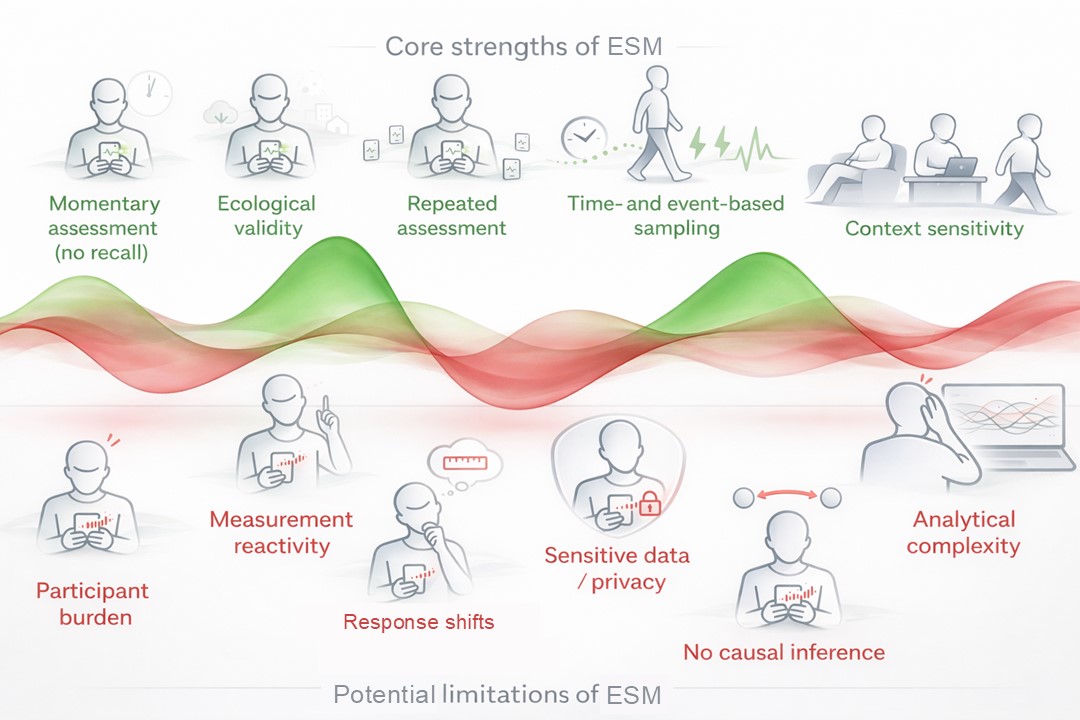
Potential limitations of ESM
Burden, missingness and inattentive responding
From a data quantity perspective, higher burden is typically associated with declining compliance over time, leading to poor response rates or participant attrition. While some missingness in ESM is inevitable (perhaps perfect compliance is even suspicious?), the question is to what extent missed assessments are purely random. Participants may be less likely to respond in particular situations, such as during social interactions, work tasks, or moments of heightened negative affect. Consequently, certain contexts or states may be systematically underrepresented.
From a data quality perspective, even completed assessments are not immune to burden-related effects. Participants may provide brief or inattentive responses to reduce disruption, increasing the likelihood of careless responding. This introduces additional measurement error, as responses are present but may not accurately reflect the underlying experience. Taken together, participant burden in ESM affects not only how much data is collected, but also how reliable those data are.
Measurement reactivity and interference
Demonstrating such reactivity effects empirically is challenging, as it requires disentangling genuine change from measurement-induced change. Evidence across domains such as affect, substance use, pain, body image and even suicidal urges generally suggests that these effects are small or negligible at an aggregate level. Nonetheless, this does not eliminate meaningful effects for specific individuals.
Closely related is the concept of measurement interference. At the behavioral level, prompts may disrupt ongoing activities, such as meetings, commuting, or leisure time, potentially altering behavior in the moment. At the affective level, prompts can elicit emotional responses, such as irritation, pressure to respond, or concern about missing notifications. These forms of interference highlight that ESM not only observes daily life, but may also subtly influence it.
Response shifts
As a result, observed changes in ESM data may not solely reflect true changes in the underlying construct, but also shifts in interpretation or scale usage. This complicates the interpretation of within-person change, as apparent trends may partly be driven by reporting processes rather than actual experience.
Privacy and ethical considerations
No causal claims
Analytical challenges
What research questions can ESM answer?
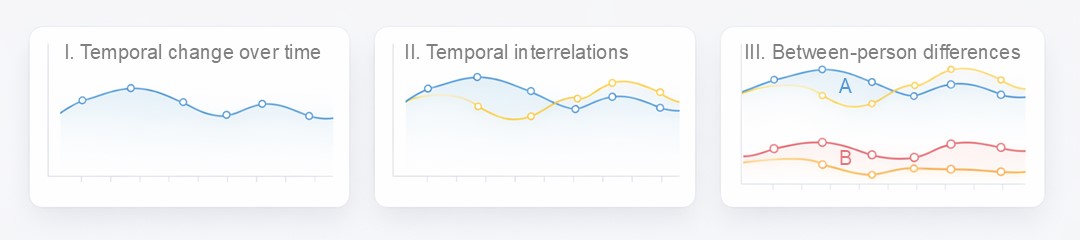
Investigating psychological constructs over time
Investigating temporal interrelations between psychological constructs
Relatedly, ESM lets researchers investigate temporal relationships, for instance whether stress at one moment predicts pain symptoms at a later time (and vice versa). These lagged relationships are particularly informative, as they provide insight into the temporal ordering of psychological processes and help identify potential predictive chains underlying behavior and experience (i.e., so-called micro-processes).
Investigating between-person differences in temporal variability patterns
Such research questions are typically analyzed using multilevel models, which account for the hierarchical structure of repeated measurements nested within individuals and enable the simultaneous estimation of within-person processes and between-person variability.
Roots and history of ESM
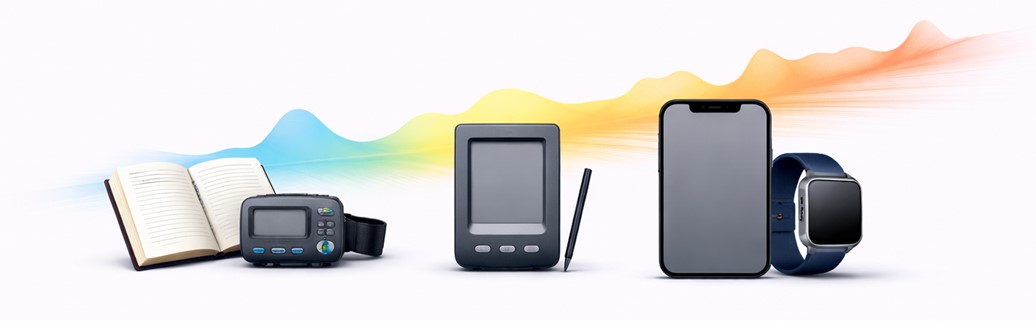
It was within this context that Mihaly Csikszentmihalyi and Reed Larson developed ESM as a research method. Their early work involved signaling participants at random moments during the day through programmable watches and asking them to report on their current experiences in a paper booklet. This approach was designed to capture the flow of everyday life, including how individuals think, feel, and act in different situations. Their results highlighted that ESM captures aspects of experience that are difficult or impossible to assess using retrospective methods, thereby establishing the value of ESM as a scientific tool.
The earliest implementations of ESM thus relied on paper-and-pencil methods. Participants carried diaries and were prompted by devices such as programmable watches or pagers to complete a questionnaire when signaled. While this approach already captured the core principles of ESM, it was limited by practical challenges, such as delayed responding (i.e., the backlogging problem) or incomplete data (e.g., lost diaries).
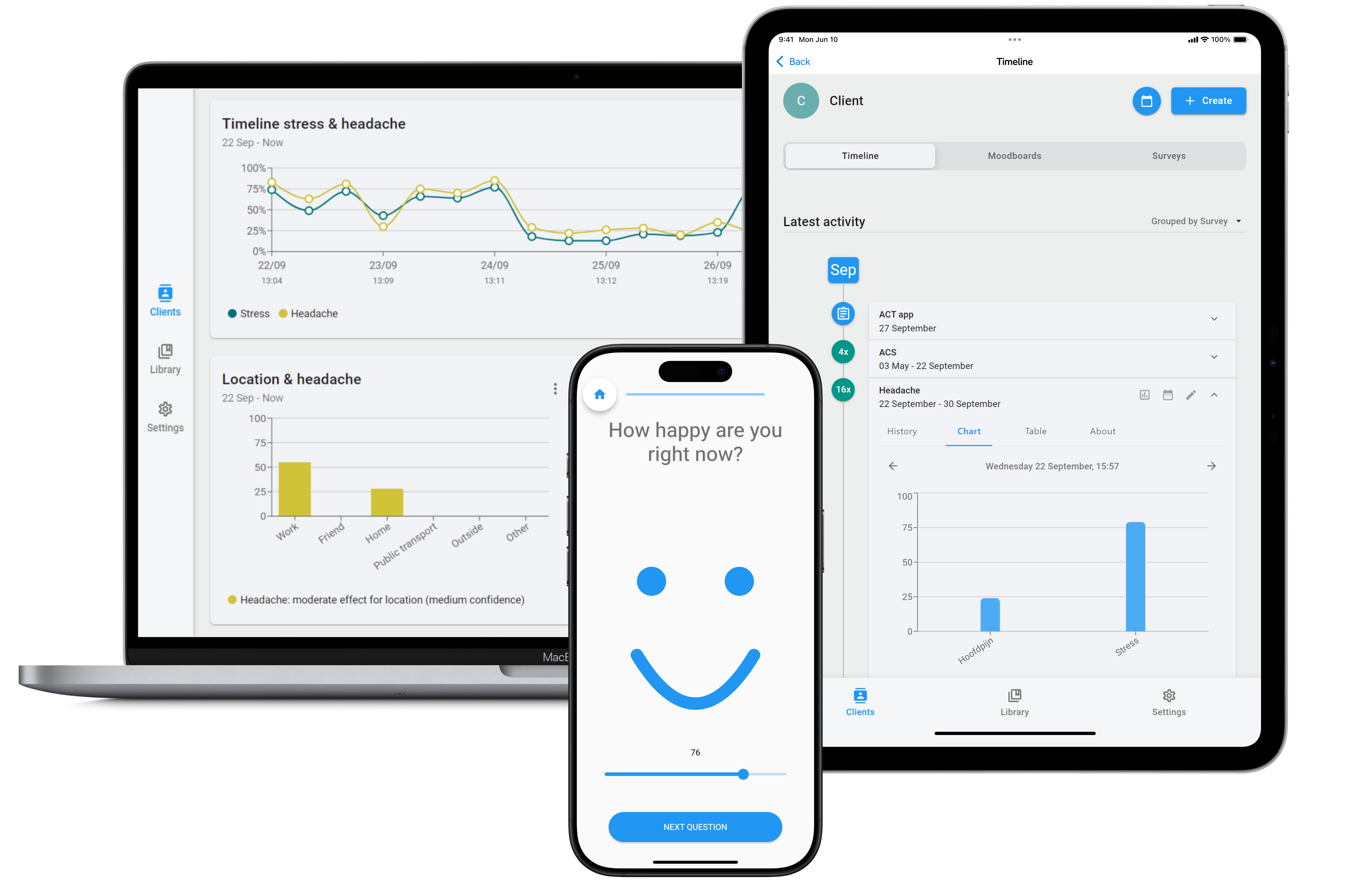
Over time, technological advances transformed how ESM studies are conducted. The transition from paper diaries to electronic devices, such as PDAs, improved the accuracy and timing of assessments. More recently, the widespread adoption of smartphones has made ESM more accessible and scalable. Modern ESM studies now typically use mobile ESM apps that automate prompting, ensure accurate time-stamping, and facilitate real-time data collection in different research domains.
How to conduct an ESM study?
A critical step is piloting the study. Pilots help determine whether the assessment frequency, survey length, and timing are manageable in participants’ everyday contexts, and whether items are interpreted as intended. They also allow you to detect technical issues early and minimize risks related to low compliance or compromised data quality.
Once data collection is underway, it is important to monitor response rates and data quality, and subsequently analyze the data using methods that account for its nested and time-dependent nature. If you are planning to run an ESM study, using a dedicated platform can facilitate study setup, data capture, and secure data management, enabling you to focus on the substantive research questions rather than technical implementation.
For a more detailed walkthrough of each stage and the associated considerations, access our step-by-step guide to running an ESM study.
Dr. Egon Dejonckheere
Egon Dejonckheere is an Assistant Professor at Tilburg University, affiliated with KU Leuven, specializing in ambulatory assessment and intensive longitudinal research. His work combines methodological innovation to improve these methods with applications in mental health and emotion dynamics, and includes dozens of smartphone-based studies in daily life.


FAQ
01.
The Experience Sampling Method (ESM) and Ecological Momentary Assessment (EMA) refer to the same general approach: collecting repeated, real-time self-reports in daily life. Although the terms originate from different research traditions and were coined by different authors, they are now used interchangeably in most research contexts.
02.
ESM captures experiences in real time or shortly after they occur, reducing reliance on memory. This minimizes recall bias, which can distort retrospective reports through reconstruction, current mood, or prior beliefs.
03.
ESM assesses individuals in their natural environments, allowing researchers to observe how psychological processes unfold in everyday life. This leads to higher ecological validity compared to controlled laboratory settings.
04.
ESM typically relies on two main sampling strategies: time-based sampling, where participants are prompted at fixed or random moments, and event-based sampling, where assessments are triggered by specific experiences or behaviors. The choice depends on the research objective and involves trade-offs between precision, burden, and coverage.
05.
ESM provides strong ecological validity and detailed insight into processes as they unfold over time, but these strengths come with important limitations. Key challenges include participant burden, incomplete data due to non-response, superficial or inattentive reporting, potential measurement reactivity, reduced experimental control, privacy considerations, and the need for advanced analytical approaches. As a result, ESM studies are typically more complex to design, execute, and interpret than traditional survey or laboratory-based methods.
06.
Measurement reactivity in ESM refers to the possibility that repeatedly prompting participants about their experiences can influence those experiences. For example, frequent assessments of mood or behavior may heighten self-awareness and lead to shifts in how people feel or act. Although evidence typically shows minimal effects at the group level, such reactivity may still be meaningful for certain individuals.
07.
Reconceptualization and recalibration represent forms of response shift in ESM. Reconceptualization occurs when participants’ understanding of a construct, such as “concentration difficulties” or “being alone,” evolves over time. Recalibration, in contrast, refers to changes in how participants use response scales, for instance becoming more conservative or more liberal in their ratings. As a result, it becomes more difficult to determine whether observed changes reflect true changes in the underlying experienceor shifts in how participants report it.
08.
ESM is particularly suited to three types of questions in everyday life: how experiences fluctuate within individuals over time, how variables relate to each other over time (both concurrently and across time points), and how individuals differ in these dynamic patterns.
09.
As opposed to paper-and-pencil diaries, smartphones with an ESM app enable automated prompting, precise time-stamping, and real-time data collection, which improves data quality and reduces issues such as delayed responding. They also allow integration with sensors and wearable devices, expanding the scope of measurement.