

Dr. Egon Dejonckheere
Egon does research in Emotion, Clinical Psychology and Abnormal Psychology. His most recent publication is 'The Bipolarity of Affect and Depressive Symptoms', featured in Journal of Personality and Social Psychology: Personality Processes and Individual Differences.




What is a daily diary study
Daily diary studies are part of the broader family of ambulatory assessment, which focuses on measuring processes in real-world contexts over time. Within this framework, they rely on repeated self-report to track how experiences change from day to day, showing close conceptual relations with approaches such as Experience Sampling Methodology (ESM) and Ecological Momentary Assessment (EMA).
Daily diary versus ESM / EMA: key differences
The key differences lie in time scale, participant burden, and the role of recall. ESM and EMA typically involve multiple assessments per day and focus on real-time or near real-time measurement. This allows researchers to capture short-term dynamics and moment-to-moment changes with high temporal precision. Daily diary methods, in contrast, operate at the level of the day, asking participants to summarize their experiences over a defined time window, usually the past day.
This lower sampling frequency has both advantages and trade-offs. On the one hand, daily diaries are less demanding for participants, which makes them more suitable for longer study durations. On the other hand, they rely more strongly on short-term recall, meaning that participants must reconstruct their day rather than report in the moment. Although this recall period is relatively brief, it can still introduce biases, for example by overemphasizing salient or recent events.
As a result, daily diary studies provide a broader, day-level perspective on psychological processes, making them particularly useful for studying how experiences accumulate and evolve across days. At the same time, they trade off some of the temporal precision and immediacy that characterize ESM and EMA.
A special case: the Day Reconstruction Method
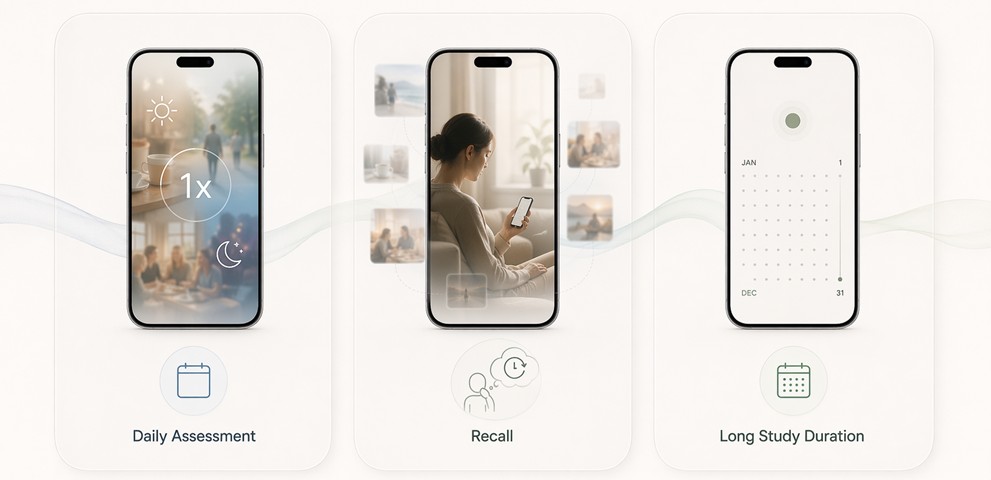
Participants reconstruct their previous day as a sequence of episodes, much like scenes in a film, and report for each episode what they were doing, where they were, who they were with, and how they felt, and so on. By anchoring reports in concrete temporal and contextual cues, this approach improves recall and reduces reliance on heuristics such as focusing only on the most salient or recent moments.
In doing so, the DRM provides a more fine-grained representation of daily experience than standard daily summaries, while remaining distinct from traditional cross-sectional surveys. Although it still relies on retrospective reporting, it has been shown to approximate momentary assessments more closely than traditional questionnaires and has been widely used in research on well-being, time use, and everyday experiences.

How to conduct a daily diary study: app-based versus web-based formats
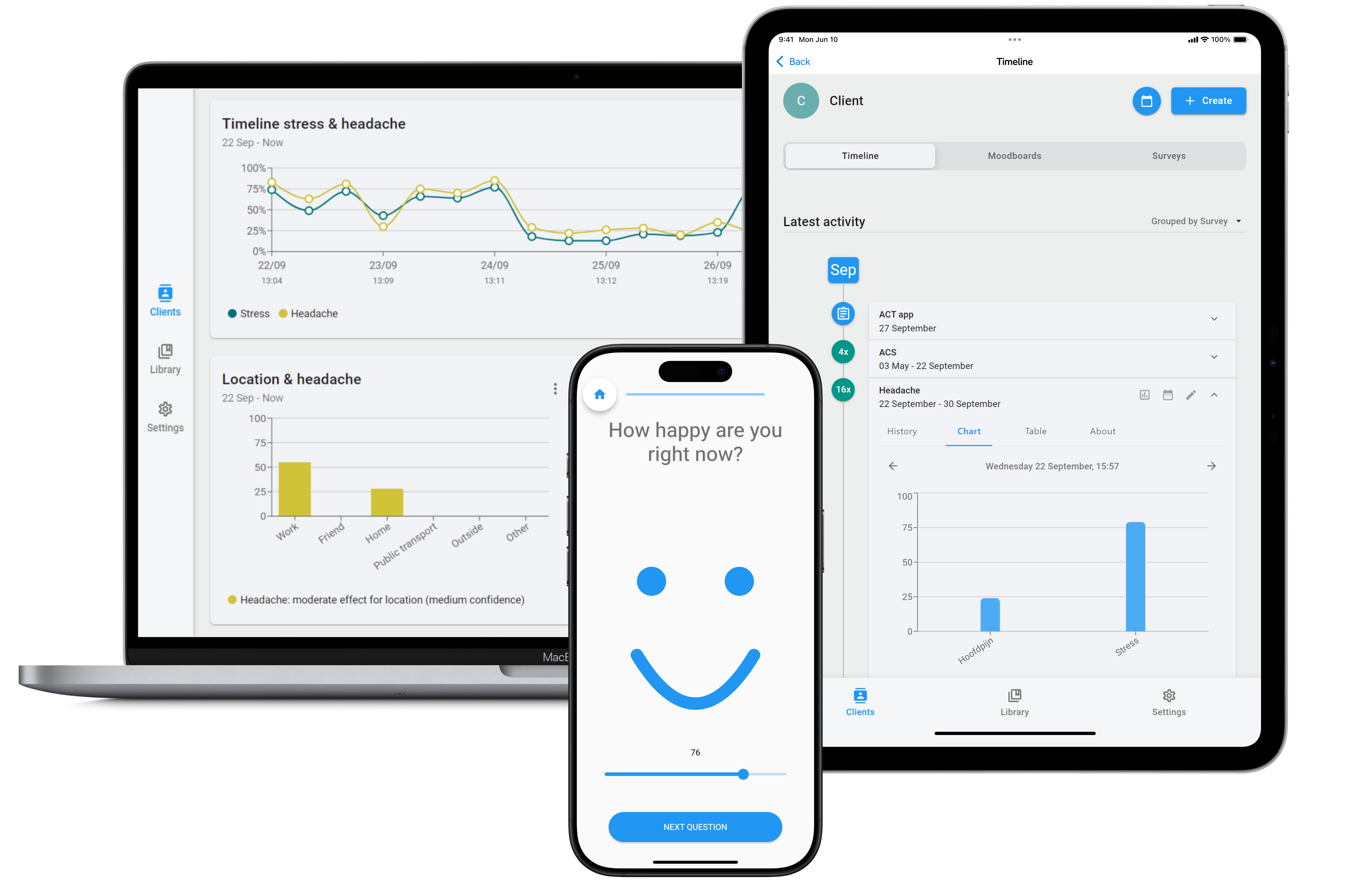
However, compared to web-based surveys, smartphone applications are more seamlessly embedded in participants’daily lives. Because people carry their phones with them throughout the day, assessments can be completed in a natural and convenient way, without requiring participants to switch devices or interrupt their routines to sit behind a computer. In addition, apps allow researchers to deliver timely reminders and notifications. These prompts help ensure that entries are completed at the intended moment, improving adherence to the study design and reducing delays or missed reports.

Taken together, this suggests that app-based daily diary study methods are not only a logistical improvement over paper or web-based formats, but also open up new methodological possibilities. By combining structured self-report with passive contextual data, they move daily diary research closer to the richness of momentary ESM and EMA, while maintaining the simplicity of a once-daily design.
Dr. Egon Dejonckheere
Egon Dejonckheere is an Assistant Professor at Tilburg University, affiliated with KU Leuven, specializing in ambulatory assessment and intensive longitudinal research. His work combines methodological innovation to improve these methods with applications in mental health and emotion dynamics, and includes dozens of smartphone-based studies in daily life.


FAQ
01.
A daily diary study is a research method in which participants report on their experiences, activities or behavior once per day, typically in the evening. These reports are collected over multiple days, allowing researchers to examine how experiences change over time in real-world settings.
02.
Daily diary studies, Experience Sampling Methodology (ESM) or Ecological Momentary Assessment (EMA) all rely on repeated assessments in daily life to study within-person processes. The main difference is timing. ESM and EMA collect data multiple times per day in real time, while daily diary studies summarize experiences at the level of the day. This makes daily diaries less detailed, but easier to implement over longer periods.
03.
Daily diary studies are most useful when your research question operates at the level of the day rather than the moment. If you are interested in day-to-day changes, longer study durations, or reducing participant burden, daily diaries may be the better choice. If you need fine-grained, moment-to-moment dynamics on a short time scale, ESM / EMA is more appropriate.
04.
The Day Reconstruction Method (DRM) is a variation of daily diary methodology developed by Daniel Kahneman and colleagues. Instead of summarizing the day as a whole, participants reconstruct their day as a series of episodes and report on each one. This approach improves recall accuracy and provides a more detailed view of how experiences unfold across the day.
05.
Both are digital options, but smartphone applications offer clear advantages. Apps are more seamlessly integrated into daily life, allow for push notifications and reminders, and can collect additional contextual data trough passive sensing. This makes app-based studies more reliable and opens up new possibilities such as context-assisted recall.
06.
Yes. When conducted via smartphone applications like m-Path, daily diary studies can be combined with passive sensing data such as location, physical activity, device usage, and so on. This additional context can enrich self-report data and improve recall accuracy.