

Dr. Egon Dejonckheere
Egon does research in Emotion, Clinical Psychology and Abnormal Psychology. His most recent publication is 'The Bipolarity of Affect and Depressive Symptoms', featured in Journal of Personality and Social Psychology: Personality Processes and Individual Differences.




What is Ecological Momentary Assessment
EMA is best understood as part of the broader family of ambulatory assessment methods, which aim to capture real-world data outside the laboratory. What distinguishes EMA within this broader framework is its focus on sampling moments of experience and behavior in context, using structured self-reports that are distributed over time. In contrast to mobile sensing, it therefore relies on active participant involvement. Conceptually, EMA closely aligns with the Experience Sampling Method (ESM), which is why many researchers use the two terms interchangeably to describe the same approach.
A helpful way to conceptualize Ecological Momentary Assessment is as a high-frequency, structured diary strategy for everyday life. Rather than attempting to measure a person’s overall experience in a single assessment, EMA collects multiple observations across time and situations. These observations are then used to reconstruct patterns of behavior, emotion, and context as they naturally unfold.

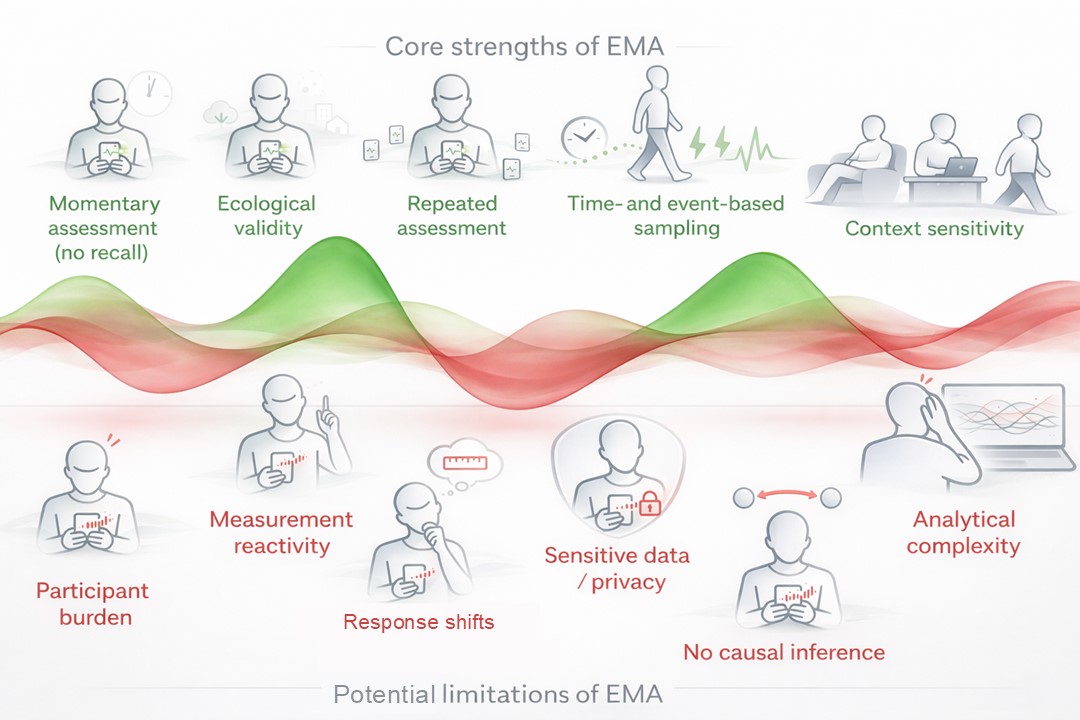
Core strengths of EMA
Momentary assessments
Ecologically Valid Data
Repeated assessments
Different types of sampling schemes
Context-dependent focus
Taken together, these characteristics make EMA a powerful method for capturing the complexity of real-world behavior. By combining momentary assessment, ecological validity, repeated observations, careful sampling, and contextual information, EMA provides a detailed and dynamic picture of how people function in daily life.
Potential limitations of EMA
Participant burden, compliance and careless responding
In terms of data quantity, higher burden typically leads to reduced EMA compliance or adherence over time, resulting in missing observations or even drop-out. While some missingness is to be expected, a more important question is whether this missingness is fully random. Participants may be less likely to respond in specific contexts, such as when they are busy, stressed, or engaged in certain activities. As a result, parts of daily life may be systematically underrepresented in the final dataset of experiences.
In terms of data quality, even when participants do respond, high burden can lead to more superficial or inattentive answers. Participants may rush through assessments to minimize disruption, increasing the likelihood of careless responding. This introduces additional noise or measurement error that is conceptually distinct from missing data, as responses are present but less reliable.
Together, these issues illustrate that participant burden in EMA does not only reduce how much data is collected, but also affects how trustworthy the obtained data are.
Measurement reactivity and interference
At the same time, it is difficult to demonstrate this effect conclusively, because it requires separating true change from change caused by the measurement. Studies across different domains, such as body image, pain, craving, emotions, and even suicidal ideation, generally find that these effects are small or non-existent at the group level. However, this does not mean they are irrelevant. For some individuals, repeated assessment may still meaningfully influence their experiences or behavior, which researchers should take into account.
A related concern is measurement interference, which can occur at both a behavioral and an affective level. Behavioral interference means that EMA prompts can interrupt what people are doing, such as conversations, work, or daily routines, and may therefore change their behavior prior to or in that moment. In contrast, affective interference refers to changes in how people feel as a result of the assessment itself, such as annoyance, irritation or fear of missing a notification. This distinction shows that EMA can influence both what people do and how they feel, meaning it does not only observe daily life, but may also subtly shape it.
Response shifts
These processes mean that changes in EMA data do not always reflect true changes in the underlying construct, but may instead reflect shifts in interpretation or scale use. This makes it potentially more challenging to interpret within-person variability over time, as observed trends can partly be driven by how participants report their experiences rather than by the experiences themselves.
Privacy and ethical considerations
No causal inference
Analytical complexity
What research questions can EMA answer?
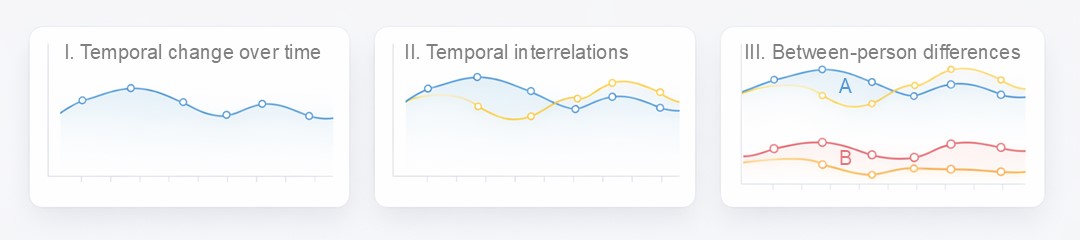
Examining psychological constructs over time
For example, in the domain of emotion, EMA can reveal diurnal patterns such as a gradual increase in irritability or anxiety over the course of the day, followed by recovery in the evening. In the domain of personality, EMA can show that characteristics typically considered stable, such as extraversion, fluctuate substantially within individuals across situations and moments, revealing that these traits are less stable in daily life than traditional cross-sectional trait measures would suggest.
Examining temporal interrelations between psychological constructs
Relatedly, researchers can examine temporal sequences and mechanisms. EMA allows researchers to examine what happens before and after specific events, such as episodes of stress, symptom onset, or behavioral lapses. By preserving the temporal order of observations, EMA enables the study of predictive chains and short-term processes, often referred to as microprocesses. For example, in pain research, EMA can reveal that increases in momentary stress are followed by elevated pain symptoms at the next assessment, which in turn predicts subsequent avoidance behavior or decreases in activity, thereby mapping out a short-term process that unfolds across hours within daily life.
Examining individual differences in temporal variability patterns
EMA thus supports both generalizable findings and more personalized insights. These patterns are typically modeled using multilevel analyses, which explicitly account for the nested structure of repeated observations within individuals and allow researchers to quantify both within-person dynamics and between-person differences simultaneously.
Roots and history of EMA
Traditional methods posed clear limitations. Laboratory studies, while offering experimental control, often failed to capture behavior as it occurs in everyday life. Retrospective self-reports, although easy to administer, were shown to be affected by memory decay, reconstruction processes, and cognitive biases, leading to systematic inaccuracies.
In response to these limitations, researchers began developing methods that directly sample experience and behavior in natural contexts. EMA drew on several earlier traditions, including daily diary studies, self-monitoring approaches in behavioral research, and Experience Sampling Methodology (ESM). The term was coined in the early 1990s and was formally introduced in the work of Arthur Stone and Saul Shiffman, who used EMA within health and clinical research contexts.
Early EMA studies relied on paper diaries and signaling devices such as pagers or programmable watches. While these methods captured the essential logic of momentary assessment, they were limited by issues such as delayed reporting (i.e., backlogging) and incomplete data (e.g., lost diary entries).
Technological advances have since transformed EMA. The introduction of electronic diaries, handheld devices, and more recently smartphones and wearable sensors has enabled more precise timing, automated prompting, and integration of multiple data streams. These developments have made EMA more accurate, scalable, and widely applicable across different research domains.

How to conduct an Ecological Momentary Assessment (EMA) study?
A crucial step is piloting the study. Pilots allow you to test whether the assesment frequency, questionnaire length, and timing are feasible in real life, and whether participants understand the items as intended. They also help identify technical issues and reduce the risk of low compliance or poor data quality in the full study.
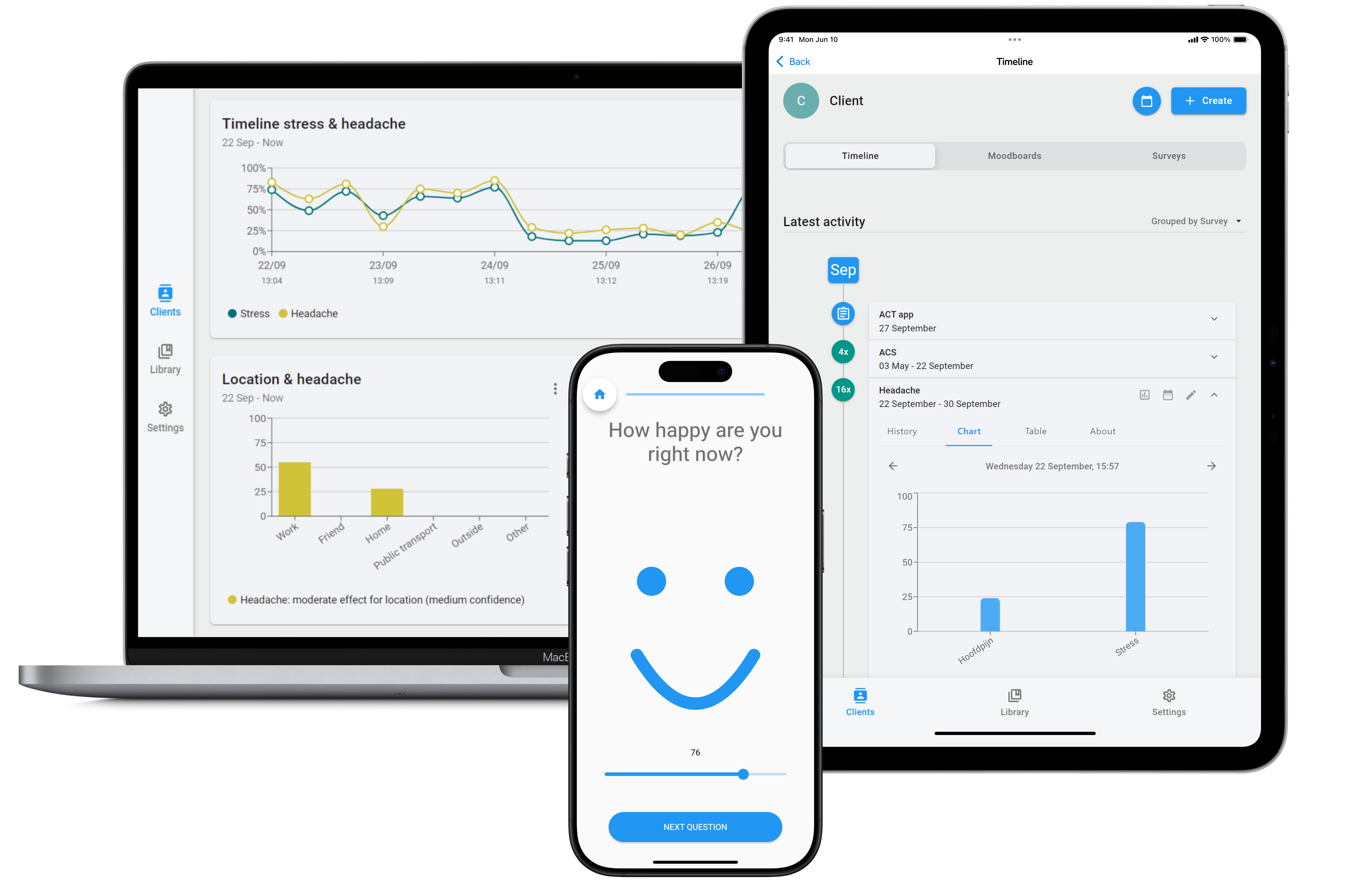
Once data collection starts, monitor compliance and data quality, and finally analyze the data using methods that account for its multilevel and time-dependent structure. If you are planning to run an EMA study, using a dedicated platform can help streamline setup, data collection, and secure data storage, allowing you to focus on your research questions rather than the technical overhead.
For a more detailed walkthrough of each stage and the associated considerations, access our step-by-step guide to running an EMA study.
Dr. Egon Dejonckheere
Egon Dejonckheere is an Assistant Professor at Tilburg University, affiliated with KU Leuven, specializing in ambulatory assessment and intensive longitudinal research. His work combines methodological innovation to improve these methods with applications in mental health and emotion dynamics, and includes dozens of smartphone-based studies in daily life.


FAQ
01.
Ecological Momentary Assessment (EMA) and the Experience Sampling Method (ESM) refer to the same research approach: collecting repeated, real-time self-reports in daily life. The terms originate from different research traditions, but are now used interchangeably in most scientific contexts.
02.
EMA is more accurate than traditional surveys because it measures experiences in real time rather than relying on memory. This reduces recall bias, which occurs when people reconstruct past experiences using heuristics, current mood, or beliefs.
03.
EMA is better than traditional lab research because it measures experiences in real time in everyday life, increasing ecological validity. It allows researchers to capture how psychological processes unfold in people’s actual lives, rather than relying on artificial settings or single-point measurements.
04.
The main EMA sampling methods are time-contingent (assessments scheduled at fixed or random times) and event-contingent (reports triggered by specific events or experiences, including those detected via sensors such as changes in location or physiological signals). Choosing between these approaches depends on your research question, as each comes with its own advantages and limitations in terms of burden, precision, and ecological validity.
05.
EMA offers high ecological validity and detailed temporal data, but it comes with trade-offs. The main disadvantages include participant burden, missing data, careless responding, measurement reactivity, reduced experimental control, privacy concerns, and analytical complexity. These challenges make EMA studies more demanding to design, run, and interpret compared to traditional surveys or laboratory studies.
06.
Measurement reactivity refers to the idea that repeatedly asking participants about their experiences can change those experiences. For example, frequent questions about mood or symptoms may increase self-awareness and lead to changes in behavior or emotional intensity. While research generally finds small effects at the group level, reactivity can still be meaningful for individual participants.
07.
Reconceptualization and recalibration are types of response shifts. Reconceptualization occurs when participants change how they understand a concept, such as “stress” or "social company”, over time. Recalibration refers to changes in how participants use response scales, for example becoming stricter or more lenient. These shifts make it harder to determine whether observed changes reflect real changes or changes in reporting.
08.
EMA can answer three core types of research questions in daily life: how a single psychological variable changes over time, how different variables relate to each other over time, and how individuals differ in their patterns of variability and dynamics in these variables.
09.
Smartphones with an EMA app improve data quality by enabling real-time prompts, automatic time-stamping, and compliance tracking. This reduces backfilling and missing data, and allows integration with sensors and wearable devices. In some cases, however, paper-and-pencil EMA may still be a viable option.