

Dr. Egon Dejonckheere
Egon does research in Emotion, Clinical Psychology and Abnormal Psychology. His most recent publication is 'The Bipolarity of Affect and Depressive Symptoms', featured in Journal of Personality and Social Psychology: Personality Processes and Individual Differences.




EMI vs JITAI: what is the difference?
An EMI may send a coping exercise at a planned time, after a participant reports stress, or when a client actively asks for support. A JITAI goes further. It uses incoming data, such as self-report, sensor data, location, activity, or previous responses, to decide whether support is needed, when it should be delivered, and what type of support fits the moment.
This means the two terms are related, but not interchangeable. A JITAI can often be understood as a more adaptive form of EMI. Not every EMI is a JITAI, but many JITAIs fall under the broader EMI tradition.
For researchers, this distinction matters because it affects how you design triggers, collect data, define decision rules, manage participant burden, and evaluate effects.
A shared starting point and core similarities
Both approaches are based on the idea that symptoms, behaviors, emotions, cravings, stress, motivation, pain, and social contexts fluctuate across the day. These fluctuations often create moments when support would be most relevant, but traditional interventions may not reach people at those moments.
Skills practiced in the safe setting of the therapy room also do not always transfer easily to real life, where clients may quickly fall back into old habits or face time pressure, complex situations, and unexpected stressors. EMI and JITAI try to bridge this gap by providing support while people are actually living through the relevant experience.
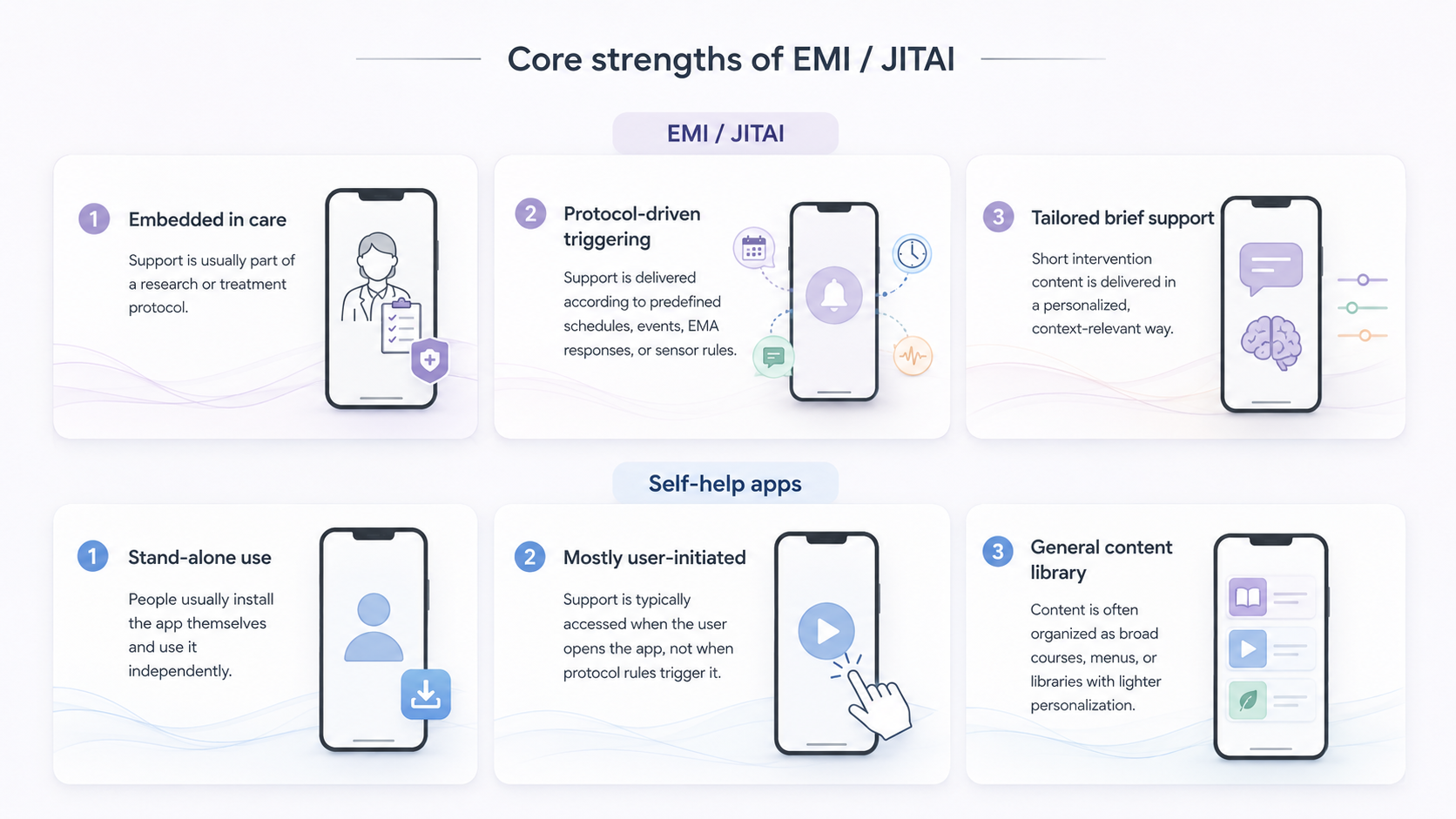
Consequently, they are usually embedded in a therapeutic or treatment context, with involvement from a researcher or practitioner. This distinguishes them from stand-alone or self-help apps (e.g., Calm or Headspace), where people simply install a mobile app themselves and engage with therapeutic content independently.
Both can be designed as protocol-driven mobile interventions that define when support is offered, what content is delivered, and how the intervention fits the broader study or treatment design.
Protocol-driven triggering
Support can be linked to some kind of schedule, whether it is a participant-reported event, an EMA response, sensor-informed input, or another predefined condition in the study protocol. The key point is that intervention delivery is designed in advance by the researcher or clinician. The mobile system is not simply a library of content. It actively supports the intervention plan.
This contrasts with many stand-alone apps, such as meditation or well-being apps, where support is mainly user-initiated. The user opens the app when they feel like meditating, reflecting, sleeping, or relaxing. In EMI and JITAI designs, support is embedded more directly into the study or treatment protocol.
Brief and specific intervention content
This content may include coping prompts, mindfulness exercises, behavioral activation tasks, psycho-education, reminders, feedback, self-monitoring tools, or short therapeutic exercises. The goal is not to recreate a full therapy session on a phone, but to deliver small, usable intervention components in the contexts where they may be relevant.
Stand-alone apps also provide intervention content, but that content is often organized as a general course, library, or menu. In EMI and JITAI designs, content is more tightly connected to the research or clinical protocol. The intervention component is chosen because it fits a specific goal or situation in the design (e.g., medication adherence or craving reduction).
Personalization and tailoring
Personalization may involve selecting intervention modules, adapting language, assigning content based on baseline characteristics, using participant preferences, or linking support to information collected before the study (e.g., during a therapy session or pre-intervention phase). In both cases, the aim is to make the intervention more relevant than a generic one-size-fits-all mobile app.
This differs from many stand-alone apps, where personalization is often limited to broad preferences, goals, or recommended content categories, while the core modules remain largely the same for everyone. In EMI and JITAI research, support can feel much more personal because it is linked to the participant’s own characteristics, responses, or treatment goals.
Where do EMI and JITAI differ?
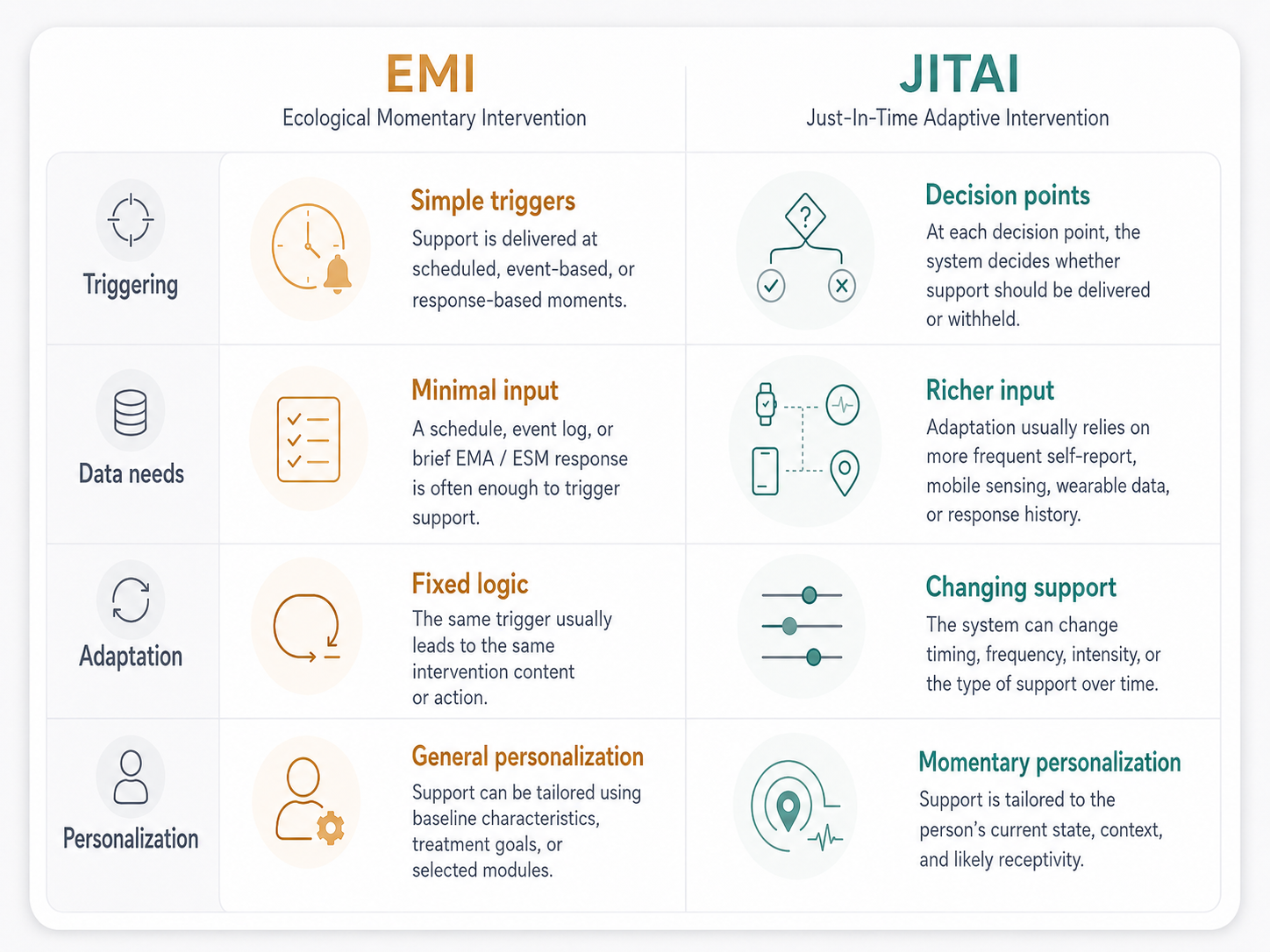
Triggering: simple triggers vs dynamic decision points
A JITAI uses decision points. At each decision point, the system evaluates whether support should be delivered. Importantly, the answer can be “no intervention”. That is part of the design: support should not be delivered when it is irrelevant, interruptive, or unlikely to help.
In practical terms, this distinction affects whether the protocol mainly needs scheduling and branching, or whether it needs repeated decision rules based on changing data.
Data needs: minimal data vs continuous input
A JITAI usually needs richer or more frequent data because adaptation depends on knowing something about the current moment. These data can come from self-report, passive mobile (e.g., GPS, phone use, etc.) or wearable (heart rate, step count, etc.) sensing, or previous response patterns.
More data is not automatically better. Passive data can be noisy, incomplete, privacy-sensitive, or hard to interpret. The intervention delivery of a JITAI depends on the quality of its incoming data.
Adaptation: fixed logic vs changing support
In a JITAI, intervention delivery can change over time. The system may choose between intervention options, adjust timing, reduce frequency, intensify support, or withhold intervention based on the current state and previous data.
In practical terms, this means JITAI design requires more explicit planning: What are the tailoring variables? What are the decision points? What are the intervention options? What rules determine action or inaction?
Personalization: global vs momentary tailoring
A JITAI additionally personalizes at the momentary level. It infers what is happening now: Is the person currently stressed? Is this a high-risk context? Is the person receptive to support? Has this intervention already been delivered recently? Would another type of support be better?
This is why “personalized” is not the same as “adaptive”. A mobile intervention can be personalized without being a JITAI.
Design complexity: one-person protocol vs team effort
A JITAI usually requires more multidisciplinary design work. Because support adapts to changing states and contexts, the team needs to define tailoring variables, decision points, intervention options, and decision rules. This often requires combined input from behavioral scientists, clinicians, statisticians, data scientists, and software developers.
EMI vs JITAI: which design should you choose?
Choose EMI when support can be planned or simply triggered
EMI is often the better choice when the intervention moment is predictable, the participant can identify the relevant event, or a simple response rule is enough. Examples include daily reflection exercises, medication reminders, coping prompts after self-reported stress, or therapeutic homework between sessions.
EMI is also a good starting point for feasibility studies. Before building an adaptive system, researchers may first need to know whether participants accept the intervention, complete prompts, understand the content, and tolerate the schedule.
Choose JITAI when timing and context are central
JITAI is especially relevant for short-lived or context-dependent states such as craving, panic, rumination, suicidal ideation, stress peaks, sedentary behavior, emotional eating, or relapse risk. In these cases, support may be ineffective if it arrives too early, too late, or at a moment when the person cannot engage.
A JITAI is appropriate when the research question is explicitly about adaptive intervention logic. For example: Does support work better during high-risk moments? Should intervention be withheld when receptivity is low? Which prompt works best for which state?
The verdict
In other words: EMI simply extends support into daily life. JITAI goes one step further, and tries to make that support arrive at the moment where it can have the greatest impact.
This does not mean that JITAIs are always better. It means they are more demanding to design well. A simple EMI may be the stronger choice when the intervention logic is clear and does not require continuous adaptation. A JITAI becomes more appropriate when the study depends on detecting dynamic moments of need, opportunity, and receptivity.
Dr. Egon Dejonckheere
Egon Dejonckheere is an Assistant Professor at Tilburg University, affiliated with KU Leuven, specializing in ambulatory assessment and intensive longitudinal research. His work combines methodological innovation to improve these methods with applications in mental health and emotion dynamics, and includes dozens of smartphone-based studies in daily life.


FAQ
01.
A Just-In-Time Adaptive Intervention (JITAI) can often be understood as a more adaptive form of Ecological Momentary Intervention (EMI). Both approaches deliver support in daily life, but a JITAI adds dynamic decision-making based on current information about the participant, such as self-report, context, sensor data, or previous responses.
02.
EMI and JITAI are usually protocol-driven interventions embedded in a research or treatment context. Stand-alone apps, such as meditation or well-being apps, are usually user-initiated: the user opens the app when they want support. EMI and JITAI define support in advance as part of a study or treatment design.
03.
Yes. An EMI can be personalized based on baseline characteristics, treatment goals, clinician input, participant preferences, or earlier study information. However, personalization alone does not make an intervention a JITAI. A JITAI adapts support to changing states and contexts over time.
04.
No. JITAIs are not always better than EMIs. A simple EMI may be the stronger choice when the intervention logic is clear, the timing is predictable, or continuous adaptation is unnecessary. A JITAI is more appropriate when the study depends on detecting dynamic moments of vulnerability or opportunity, in combination with high receptivity.