

Dr. Egon Dejonckheere
Egon does research in Emotion, Clinical Psychology and Abnormal Psychology. His most recent publication is 'The Bipolarity of Affect and Depressive Symptoms', featured in Journal of Personality and Social Psychology: Personality Processes and Individual Differences.




What is passive sensing?
Passive sensing is part of the broader family of ambulatory assessment methods, which aim to capture real-life data outside the lab room. What distinguishes passive sensing within this framework is its reliance on device-based measurements rather than self-report, combining embedded sensors to approximate patterns of activity, mobility, social context, and physiology. In contrast to Ecological Momentary Assessment (EMA), Experience Sampling Methodology (ESM) or daily diary designs, it therefore does not require active participant input. Instead, it complements these approaches by capturing behavioral and contextual processes that may be difficult, impractical, or impossible to assess through self-report alone.
A helpful way to conceptualize passive sensing is as a continuous data layer underlying everyday life. Rather than sampling discrete moments through repeated assessments, passive data collection generates high-resolution streams of data over time. These data can be used not only to reconstruct patterns of behavior and context, but also to detect meaningful changes as they occur. In more advanced designs, such changes can also be used to trigger new assessments or interventions in real time, enabling a shift from static measurement toward dynamic, context-aware research and intervention systems (e.g., Just-in-time Adaptive Interventions).
Core strengths of passive sensing
However, passive sensing differs fundamentally in how data are collected and structured. Its key strengths stem from the fact that measurement is automated, continuous, and independent of active participant input.
Automatic data collection
Unobtrusive measurement
Continuous time series
Long-term and scalable data collection
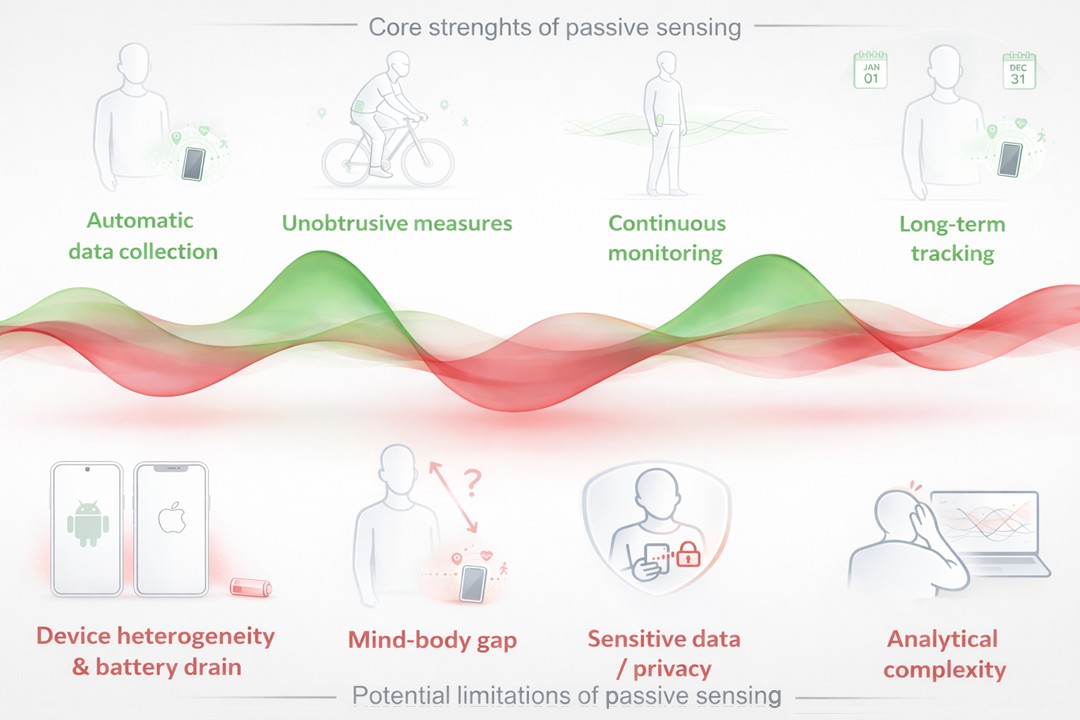
Potential limitations of passive sensing
No direct link between sensor data and psychological processes
First, a single sensing pattern can have multiple meanings: for example, reduced mobility may reflect fatigue, focused work, or social withdrawal, depending on the situation. Second, the same psychological state can show up differently in sensing data across people or contexts: for example, stress may lead to increased phone use and restlessness in one person, but to withdrawal, reduced activity, or longer periods at home in another.
As a result, sensor data do not provide direct access to psychological states such as thoughts or emotions, and interpretation often requires combining multiple objective signals and integrating subjective self-report to draw reliable conclusions.
Device heterogeneity and battery consumption
Second, even within the same device, data collection can be disrupted by operating system restrictions, app termination, and battery optimization processes that limit background activity. These constraints are particularly relevant for smartphones, where sensing competes with other apps and battery use. Wearables are often designed for continuous sensing, but their data quality depends on consistent and correct use.
Privacy and ethical concerns
More fundamentally, it changes the nature of measurement: instead of relying on what participants actively choose to report, data are passively observed in the background. This shift requires careful attention to transparency, participant control, and ongoing awareness of what is being collected.
Analytical complexity
Common sensors and approaches in passive sensing
Smartphones versus wearables
- GPS: location, mobility patterns, time spent at home versus outside
- Accelerometer: movement, activity levels, sedentary behavior
- Screen unlocks and app usage: phone engagement (calls, messages, app interactions)
- Bluetooth: proximity to others, social context proxies
- Microphone: environmental context such as noise levels
- Wi-Fi: public versus private space
- Heart rate: physiological arousal, stress-related patterns
- Heart rate variability (HRV): recovery and regulation processes
- Step count and activity intensity: physical activity and energy expenditure
- Sleep metrics: duration, timing, and fragmentation of sleep
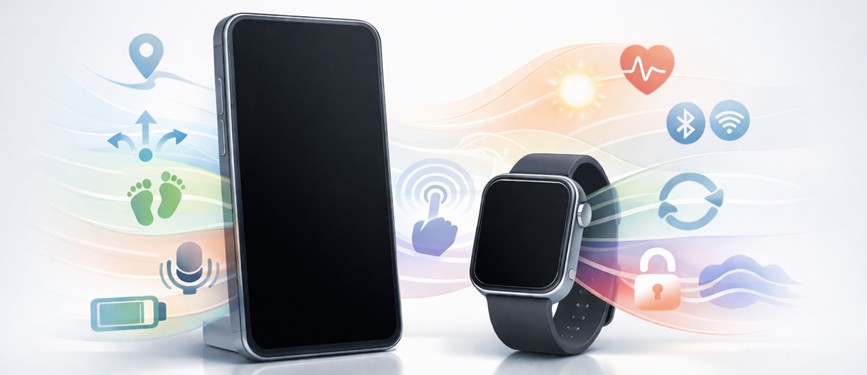
Full versus lite sensing
In contrast, lite sensing means that the sensor data are only collected at specific moments, such as during EMA or ESM assessments. This reduces battery usage and is typically less intrusive, while giving more control over when data are captured. However, it provides only momentary snapshots or sensing aggregates between assessments.
The choice between full and lite sensing depends on the research question, privacy considerations, and practical constraints, reflecting a trade-off between data richness and feasibility.
The relation between passive sensing and EMA or ESM
First, passive sensing and EMA or ESM can be treated as complementary sources of information. Sensing captures objective indicators of behavior and context, while EMA or ESM captures subjective experiences such as thoughts, emotions, and appraisals. Combining both allows researchers to link what people do and where they are to what they feel, leading to a more complete understanding of real-life processes.
Second, they can be partially interchangeable. In some cases, sensor data can replace or reduce certain self-report questions, such as those related to activity (e.g., What are you doing right now?), location (e.g., Where are you right now?), or device use (e.g., How many minutes have you used your smartphone since the last prompt?), thereby lowering participant burden. However, this interchangeability is limited to constructs that can be reasonably approximated by sensors and does not extend to subjective experience.
Finally, passive sensing can be used to support and inform EMA or ESM study design. It can help define more efficient sampling schemes by triggering assessments at meaningful moments, such as changes in behavior or context. This shifts measurement from traditional time-based schedules toward context-aware designs that focus on when something relevant actually happens.
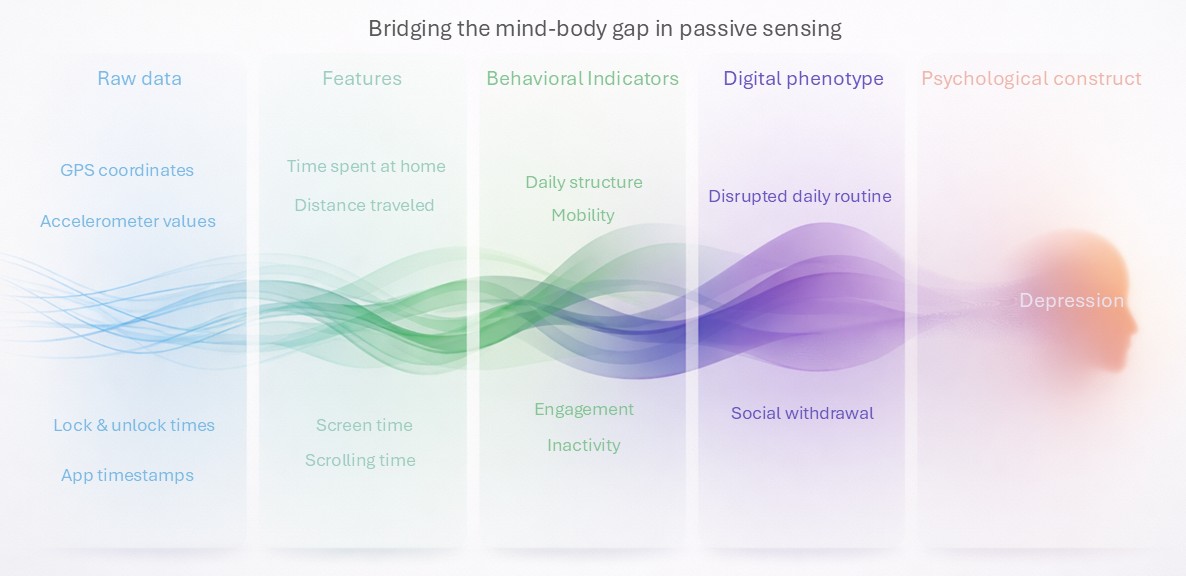
Bridging the mind-body gap in passive sensing
From raw signals to features
From features to behavioral indicators
From behavioral indicators to digital phenotypes
Linking digital phenotypes to psychological constructs
Because each step involves assumptions, validation is essential. Researchers should test whether mobility-based digital phenotypes relate to reported mood and refine their models accordingly.
Roots and history of passive sensing
From ambulatory assessment to digital sensing
The "quantified self" and precision medicine
More recently, passive sensing has become closely linked to developments in precision or personalized medicine, which aim to understand and predict individual-specific patterns rather than relying on group-level averages. By continuously capturing data in daily life, mobile sensing supports more personalized, data-driven approaches to research and care.
Dr. Egon Dejonckheere
Egon Dejonckheere is an Assistant Professor at Tilburg University, affiliated with KU Leuven, specializing in ambulatory assessment and intensive longitudinal research. His work combines methodological innovation to improve these methods with applications in mental health and emotion dynamics, and includes dozens of smartphone-based studies in daily life.


FAQ
01.
Passive sensing is a research method that uses smartphones and wearable devices to automatically collect data on behavior, context, and physiology in daily life. Unlike surveys, it does not require active input from participants and can capture data continuously in real-world environments.
02.
Passive data collection enables continuous, real-world data collection with minimal participant burden. It provides high-resolution time series data, captures behavior that is difficult to self-report autonomously and without interference, and allows for long-term monitoring of daily life patterns.
03.
Key limitations of passive sensing include the lack of a direct link between sensor data and psychological states, variability across devices, battery and technical constraints, privacy concerns, and the complexity of analyzing large, high-frequency datasets.
04.
Passive sensing can collect data such as location (GPS), movement (accelerometer and gyroscope), smartphone usage (app interactions, keyboard strokes), social proximity (Bluetooth), heart rate (variability), activity levels, and sleep patterns. The exact data depend on the sensors available on smartphones and wearable devices.
05.
A digital phenotype is a pattern of behavior derived from sensor data. It often combines multiple indicators, such as mobility, activity, and phone use, to approximate psychological processes like mood, stress, or symptoms in daily life.
06.
No, passive data collection does not directly measure thoughts or emotions. Instead, it provides indirect indicators based on behavior and physiology. These indicators need to be interpreted carefully and are often combined with self-report data to draw reliable conclusions.
07.
Precision or personalized medicineis a healthcare and research approach that tailors prevention and treatment to the individual rather than relying on group averages (i.e., one-size-fits-all approach). By using detailed, often continuous data, such as lifestyle data and sensor-based measurements, it seeks to identify individual-specific patterns and deliver more targeted and effective care.