

Dr. Egon Dejonckheere
Egon does research in Emotion, Clinical Psychology and Abnormal Psychology. His most recent publication is 'The Bipolarity of Affect and Depressive Symptoms', featured in Journal of Personality and Social Psychology: Personality Processes and Individual Differences.




EMA vs ESM: is there a real difference?
Rather than representing fundamentally different methods, EMA and ESM can best be understood as conceptually related approaches within the broader umbrella of ambulatory assessment, with only subtle differences in their historical roots and original emphasis.
Ambulatory assessment refers to a family of methods designed to capture data in real-world settings over time, both active and passive. Within this broader framework, both EMA and ESM focus specifically on active, structured self-report, meaning that participants report on their subjective experiences and behavior using standardized questions multiple times per day while going about their daily lives.
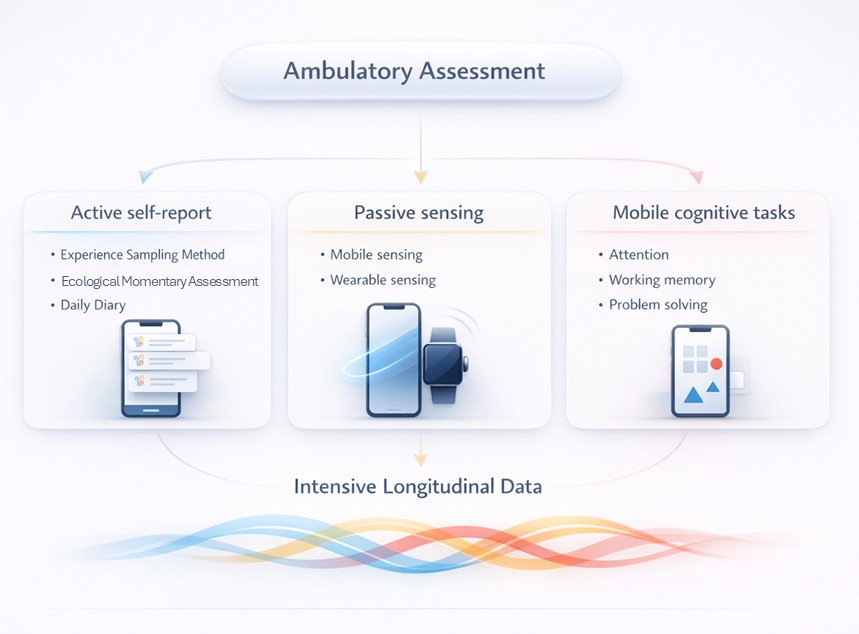
A shared starting point and core similarities
EMA and ESM were developed as solutions to these limitations, with a shared goal of capturing behavior and experience as they naturally unfold. This common foundation explains why the two approaches are so closely aligned.
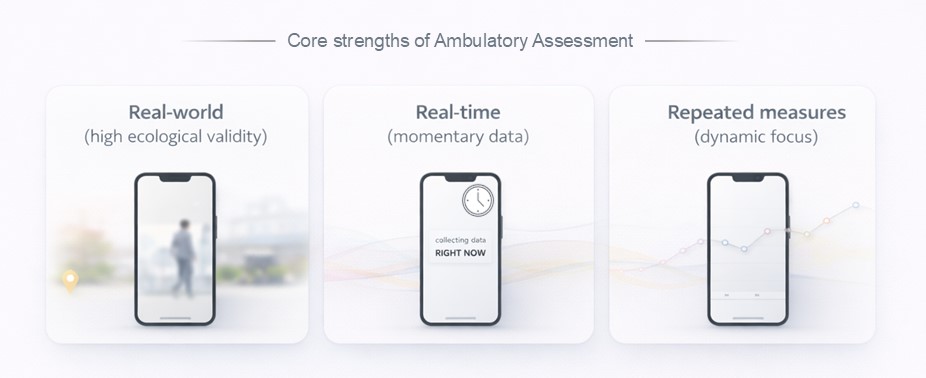
- First, both rely on real-time or near real-time assessment. Participants report on their current state or very recent experiences, which reduces reliance on memory and allows for more accurate measurement. Rather than summarizing across long periods, both EMA and ESM sample specific moments.
- Second, both are conducted in real-world contexts. Data are collected while participants go about their daily lives, ensuring that findings reflect natural behavior and increasing ecological validity.
- Third, both use repeated measurements over time. By assessing participants multiple times per day across several days or weeks, EMA and ESM generate intensive longitudinal data that capture within-person variability, fluctuations over time, and dynamic relations between variables.
Where do EMA and ESM differ?
- ESM originated in the 1970s within social and personality psychology, particularly through the work of Mihaly Csikszentmihalyi and colleagues, and was primarily developed to study students' subjective experience in daily life, such as emotions, thoughts, and momentary awareness (flow). Its central aim was to capture the phenomenology of everyday life, that is, how people experience their world from moment to moment.
- EMA emerged somewhat later within clinical psychology and behavioral medicine in the 1990s. The term was coined by Arthur Stone and colleagues. From the outset, their work focused not only on subjective experience but also on observable behaviors and symptoms in real-world contexts. In this sense, EMA was designed as a more inclusive methodological framework that integrates multiple types of real-time data beyond purely internal experiences like emotions or appraisals.
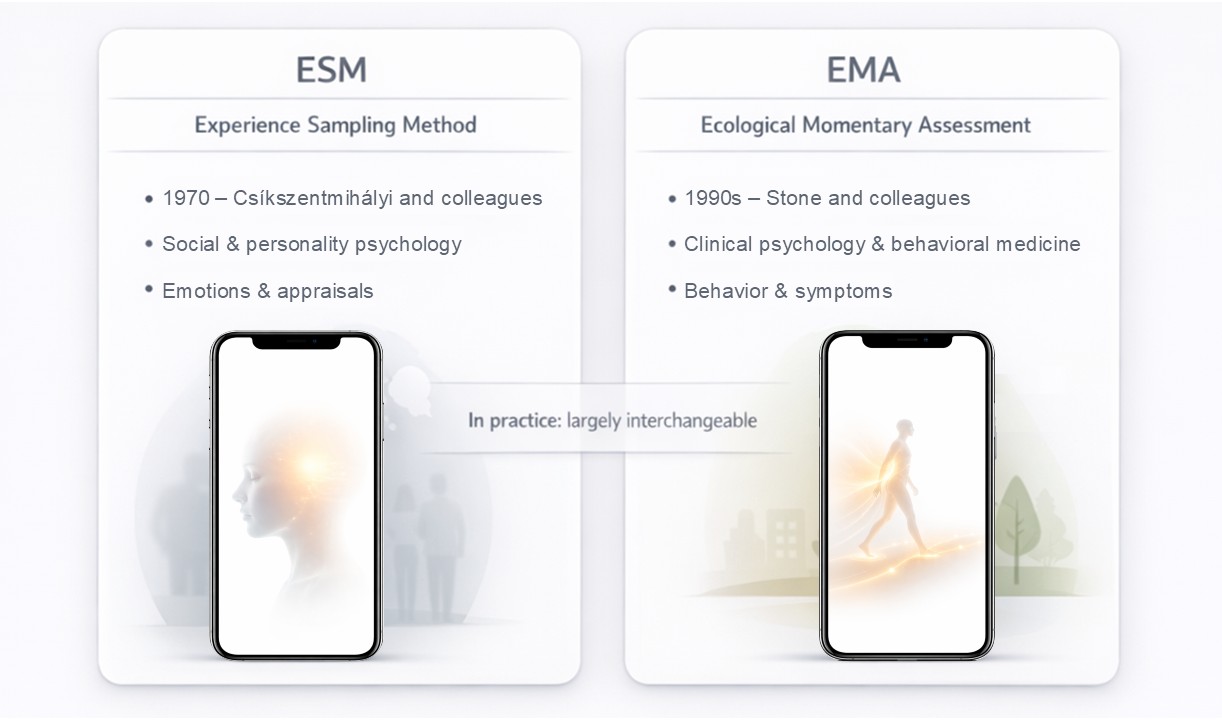
As a result, the distinction between EMA and ESM is often minimal, and the choice of terminology typically reflects disciplinary background rather than a fundamental difference in method.
The verdict
Both were developed to overcome the limitations of retrospective and laboratory-based research. Both rely on real-time assessment, repeated measurements, and naturalistic data collection. Both are part of the broader ambulatory assessment framework, with a shared focus on structured self-report in daily life.
Their differences are primarily historical, reflecting distinct starting points rather than fundamentally different methodologies. In practice, they converge on the same core idea: to understand human behavior and experience as it unfolds in the real world.
Dr. Egon Dejonckheere
Egon Dejonckheere is an Assistant Professor at Tilburg University, affiliated with KU Leuven, specializing in ambulatory assessment and intensive longitudinal research. His work combines methodological innovation to improve these methods with applications in mental health and emotion dynamics, and includes dozens of smartphone-based studies in daily life.


FAQ
01.
In most cases, yes. ESM (Experience Sampling Method) and EMA (Ecological Momentary Assessment) refer to the same general approach of collecting repeated, real-time self-report data in daily life. The difference is mainly historical, and the terms are used interchangeably in modern research.
02.
Yes. Both methods typically use similar sampling strategies, such as time-based prompts or event-based assessments, and generate intensive longitudinal data that can be analyzed at both within-person and between-person levels.
03.
Yes. Both EMA and ESM fall under the broader umbrella of ambulatory assessment, which includes all methods that capture data in real-world settings over time. Within this overarching category, EMA and ESM focus on active self-report through structured surveys.