

Should you brief your ESM / EMA participants online or in person?
TL;DR
Briefing participants in person takes time, travel, rooms, and scheduling. A new quasi-experimental study compared the impact of online versus in-person briefings before a seven-day experience sampling (ESM) / ecological momentary assessment (EMA) protocol. On average, the two briefing formats produced similar compliance, data quality, participant burden, and perceived briefing sufficiency. Only the shape of compliance over time differed: online-briefed participants started higher and declined faster, while in-person-briefed participants stayed more flat. For short and straightforward protocols, online briefings look like a viable default.
You book a room. You block 45 minutes per participant. You answer the same questions about notification settings, over and over, for six weeks. Perhaps some people no-show.
Anyone who has run an experience sampling (ESM) / ecological momentary assessment (EMA) study knows this part of the job. And it matters, because a briefing is the last moment you control. After it, participants complete the protocol alone: in their kitchen, on the bus, halfway through a shift. Whatever stayed unclear stays unclear for the rest of the week.
But is a face-to-face briefing really necessary, or can you prepare them just as well during an online session? 🤔
Online briefings are much easier to organize and make geographically broader recruitment possible. You only need internet access. The key question is whether this convenience comes at a cost.
The study at a glance
A team of our former colleagues at KU Leuven, led by Dr. Gudrun Eisele, tested this onboarding question in an actual ESM / EMA study.
The study included 249 first-year psychology students, of whom 209 received an online briefing and 40 were briefed in person. Importantly, participants were not randomly assigned to these conditions. Instead, briefing modality was determined by the recruitment phase in which they entered the study.
Quasi-experimental?
Although participants were not fully randomized across conditions, this quasi-experimental design has an important advantage over letting participants choose their preferred format. In an earlier study, Carr and colleagues (2020) found comparable EMA compliance and data quality among participants enrolled remotely versus in person. However, because participants selected their preferred enrollment format, it was difficult to distinguish an effect of modality from an effect of self-selection.
In the KU Leuven study, the briefing itself was kept as similar as possible across conditions. Both online and in-person sessions lasted 30 to 45 minutes, used the same instructional materials, and included a practice questionnaire in the m-Path app. Only the mode of delivery differed.
After the briefing, participants completed a seven-day semi-random ESM / EMA protocol with 10 prompts per day. The team then measured four outcomes: compliance as data quantity, careless responding as data quality, participant burden, and perceived briefing sufficiency.
What they found
Online briefing matched in-person briefing on the outcomes that matter:
1. Average compliance was similar.
Across the full study period, participants who were briefed online did not show significantly different average response rates from those who were briefed in person (70% vs 67%).
2. Online briefing did also not reduce data quality.
The two groups also showed no differences in careless responding. Participants briefed online were no more likely than those briefed in person to respond unusually quickly, answer inconsistently across items, or repeatedly select the same response option. Self-reported careless responding was also comparable between the two conditions.
3. Participant burden was similar.
Participants did not experience the ESM / EMA protocol as more burdensome after an online briefing, either in their momentary ratings or their retrospective evaluation.
4. Participants felt equally well prepared.
Finally, perceived briefing sufficiency did not differ between conditions. People who met the researcher online felt just as prepared for the ESM /EMA protocol as those who met the researcher in person.
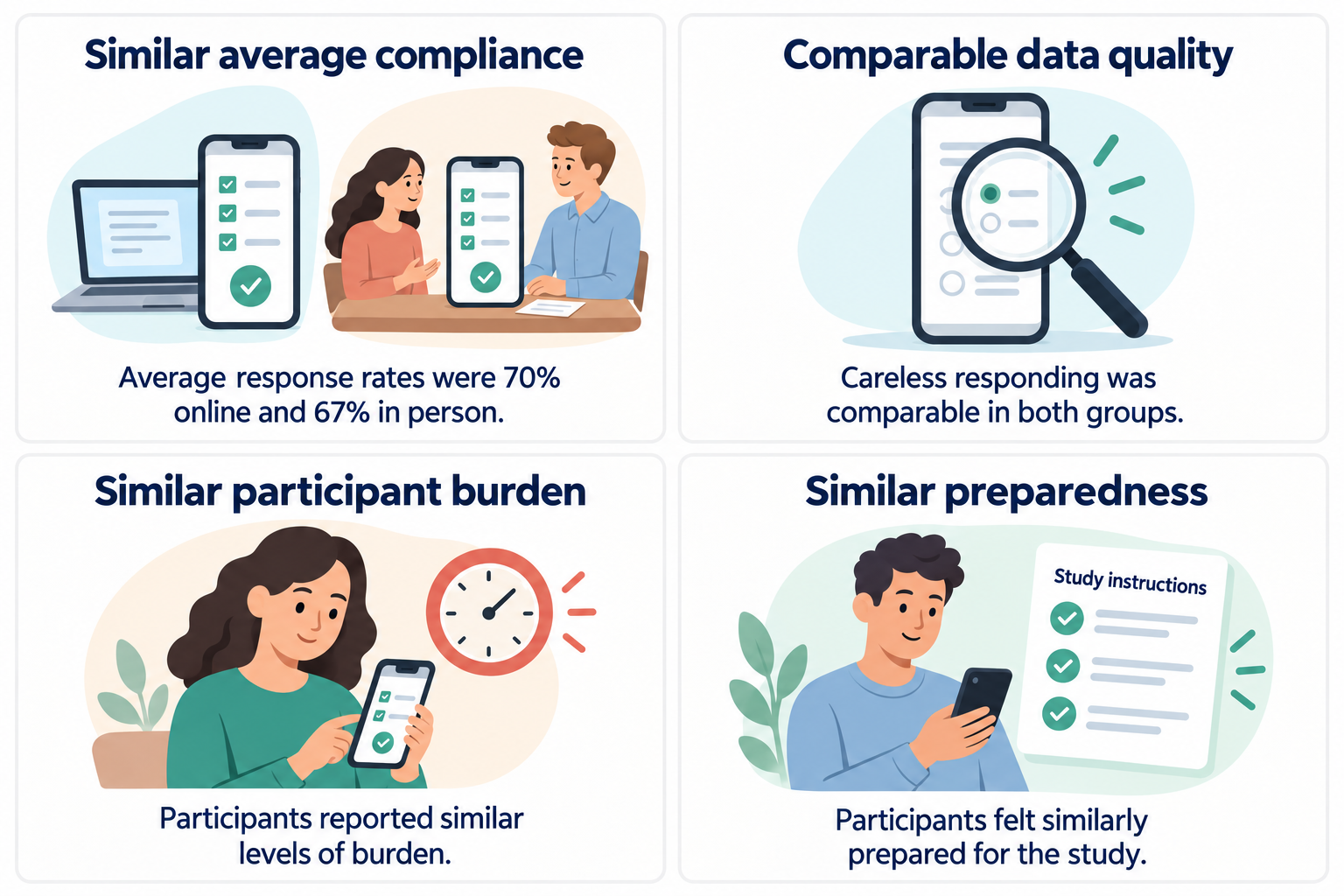
Online or in-person briefings produce similar study data.
The one difference: how response compliance decays
Averages hid something, though. When the team modelled compliance day by day, the two groups showed remarkably different patterns.
Estimated compliance in the online condition started higher but declined across the seven-day protocol. In the in-person condition, compliance started somewhat lower and remained relatively stable over time.
Both groups finished the week at 66% compliance. They simply took different routes to get there.
The research alliance
One possible (post-hoc) explanation is that meeting a researcher face to face helps establish a stronger "research alliance". Already in the early EMA / ESM literature, Larson and Csikszentmihalyi (1983) argued that participants’ study engagement depends partly on their trust in the researcher and their belief that the research is worthwhile. A stronger research alliance could therefore increase participants’ commitment to the study and help them remain engaged once the initial novelty wears off. However, the present study did not directly assess research alliance, so this explanation remains speculative.
Practical take-aways
So, should you move your next participant briefing online?
We see a few useful rules of thumb:
- Brief online for short, straightforward protocols when your participants are comfortable using smartphones and video calls.
- Consider in-person briefing for longer or more complex studies (e.g., those that involve mobile sensing), or for populations who may need more technical or interpersonal support (e.g., clinical patients or elderly) .
- Include a practice run. Let participants complete a questionnaire before day one so you can detect technical or procedural misunderstandings early.
- Invest in retention after the briefing. Regardless of modality, an initial briefing alone will not guarantee sustained compliance. Reminders, check-ins, incentives, and carefully designed gamification can help maintain engagement. Also an in-person debriefing after the ESM / EMA protocol may remediate the decline in compliance.
- Report your briefing procedure. Modality, duration, content, and whether participants completed a practice questionnaire are all easy to report and can help the field build better evidence.
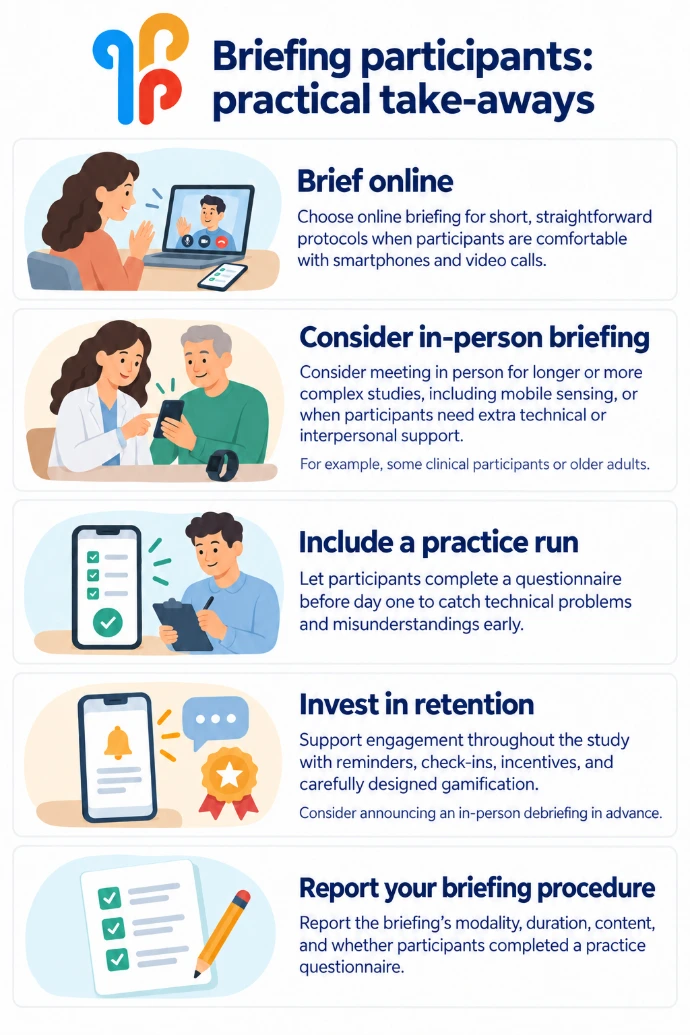
Practical take-aways for briefing participants.
Conclusion
Before you book a room for your next ESM / EMA study, answer these three questions:
- How long and how complex is my protocol?
- How digitally comfortable is my sample?
- What is my plan for week two, when the novelty wears off?
If your answers are “short”, “comfortable”, and “I have one”, online briefing will very likely serve you well. Put the hours you save into keeping people engaged after day three.
Check out our "complete guide to running an ESM / EMA study" to learn how to design, set up, and successfully run your own ESM / EMA study.
👉 Explore the full paper here: PsyArxiv, 2026.

Dr. Egon Dejonckheere is an Assistant Professor at Tilburg University, affiliated with KU Leuven, specializing in ambulatory assessment and intensive longitudinal research.
His work combines methodological innovation to improve these methods with applications in mental health and emotion dynamics, and includes dozens of smartphone-based studies in daily life.