

Does personalized feedback improve compliance in ESM /
EMA studies?
TL;DR
Participants seem to value personalized feedback in Experience Sampling (ESM) / Ecological Momentary Assessment (EMA) studies, but current evidence suggests it rarely improves compliance or recruitment. Encouragingly, it also does not appear to harm data quality, although real-time feedback may introduce measurement reactivity. One likely reason for the weak compliance may be that participants barely engage with the feedback they receive. If you offer it, make it easy to access, worth looking at, and tailored enough to provide participants with a real insight into their own data.
You just took part in a two-week experience sampling (ESM) / ecological momentary assessment (EMA) study with nine beeps per day. At the debriefing, the researcher offers you a report with graphs of your own moods. Do you take it?
Chances are high. In a recent m-Path study, Pihlajamäki and colleagues (2026) found that nearly all participants chose to receive a feedback report about their own data when given the option. Personalized feedback clearly interests participants. 📑
But if participants value their data this much, does offering personalized feedback actually make them answer more beeps? At m-Path, we reviewed the experimental and meta-analytic evidence to find out.

Would you like a personalized feedback report at the end of an ESM / EMA study?
Participants value personalized feedback on their own ESM / EMA data
Let’s start with the good news: when participants get feedback, they rate the study as more worthwhile.
In a one-month daily diary study on household spending, Wenz and colleagues (2022) randomly gave some participants access to a real-time summary of their own spending. Among those participants, 59.5% said their time and effort in the study was very well spent, compared with 37.9% of participants who received no feedback.
A similar pattern emerged in a clinical setting. In a pilot study by Boerner and colleagues (2023), young pain patients took part in a two-week ESM / EMA study and answered three beeps per day. In one of those weeks, they could also open a dashboard with live graphs of their own sleep, symptoms, emotions and worries. Of those who opened it, 56% liked seeing trends in how they were doing.
Does personalized feedback attract more participants to ESM / EMA studies?
And what about recruitment?
Giese and König (2024) invited university students to take part in a one-week ESM / EMA mood study. They randomly varied whether the invitation promised participants a report with graphs of their own mood afterwards. Slightly more students signed up when feedback was offered, 12.7% versus 8.2%, but the difference was not significant (p = .056).
Wenz and colleagues (2024) found no difference in participation likelihood. Of the invited panellists, 14.3% installed the app when feedback was mentioned in the invitation, compared to 14.2% when it was not.
Feedback may still affect who decides to participate. In Giese and König's study (2024), students who were offered feedback reported greater personal interest in the study topic. So even if feedback does not clearly boost recruitment overall, it may tilt your sample towards people who are already more interested in what you are studying.
Does personalized
feedback introduce measurement reactivity?
Besides this potential selection bias, ESM / EMA feedback may also change the very processes researchers aim to assess. Feedback can increase personal insight or make participants pay closer attention to their experiences, meaning an observational study could partly become an intervention simply because feedback is offered.
So far, there is little evidence for such an effect. Wenz and colleagues (2022) found no meaningful differences in reported spending, while Pihlajamäki and colleagues (2026) found no differences in positive or negative affect.
Still, few studies have tested this directly. For now, personalized ESM / EMA feedback does not appear to strongly promote insight and behavioral change, but measurement reactivity remains worth considering.
Does personalized feedback improve ESM / EMA response rates?
This is where the picture becomes much less exciting.
In their meta-analysis, Ottenstein and Werner (2022) found that studies promising personalized feedback did not have higher compliance or lower dropout. Wrzus and Neubauer (2023) reached a similar conclusion. Monetary incentives were associated with higher compliance, but personalized feedback was not.
Of course, these meta-analytic findings are correlational. Studies that offer feedback may differ from other studies in many ways, making causal conclusion difficult.
So what happens when researchers experimentally manipulate feedback? These studies tell a similar story.
The one clear success is also the oldest and smallest. Hsieh and colleagues (2008) let 26 laptop users view graphs of their own answers after every prompt. Compliance was 79% with feedback versus 64% without, but the control group held only eight people.
Larger and more recent studies have mostly reported null results:
- Newcomb and colleagues (2018): weekly personalized graphs did not predict survey completion during a two-month diary study.
- Wenz and colleagues (2022): participants who received feedback used the diary on 18.3 of versus on 18.5 days without it.
- Boerner and colleagues (2023): participants completed 69% of prompts during weeks with access to a live dashboard and 72% during weeks without it.
- Pihlajamäki and colleagues (2026): compliance was 86.4% when participants expected a personal report and 86.6% without one.
Does personalized
feedback improve ESM / EMA data quality?
Pihlajamäki and colleagues (2026) found no evidence that expecting personalized feedback changed how participants completed the ESM / EMA surveys. Completion times, answer variability, self-rated carelessness, and the time it took participants to open a prompt were all comparable between conditions.
This suggests that, at least in this study, personalized feedback did not improve (or reduce) ESM / EMA response quality.
Why does feedback rarely improve compliance?
A surprisingly simple explanation may be that participants often do not look at it.
- In Wenz and colleagues (2022), 21% of participants who had access to feedback never opened their summary. Those who did only spent about 2 minutes viewing it across the entire month.
- In Boerner and colleagues (2023), 52% never viewed their dashboard. Some participants couldn’t find it, some felt too busy or simply forgot, and one individual simply did not want to look.
- In our own gamification study (Dejonckheere and colleagues, 2024), we saw something similar. Of the 128 participants, 45 never bought a single reward. Interest in spending coins on personal graphs averaged only 2.24 on a 7-point scale.
So how does this fit with the finding that participants seem to value personalized feedback? Appreciating feedback is not the same as being motivated by it. The participants who rate feedback positively are often the ones who actually looked at it, and even a brief glance may be enough to find a personal summary interesting or worthwhile.
There is also a difference between wanting a report afterwards and thinking about that report when the next beep arrives. Pihlajamäki and colleagues (2026) illustrate this nicely: almost everyone wanted to receive their personal report, yet expecting that report did not change how participants responded during the study.
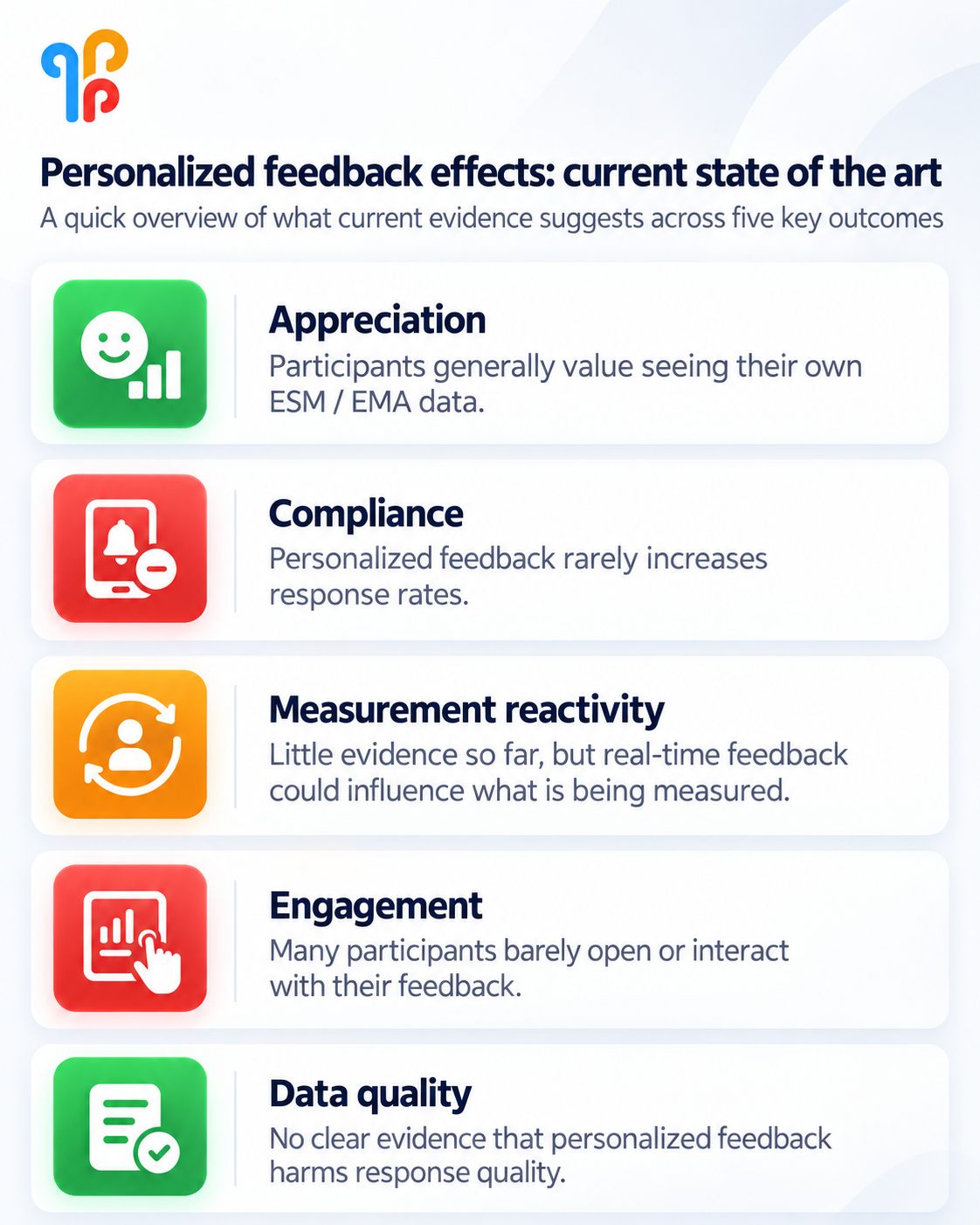
Effects of personalized feedback in ESM / EMA.
Practical take-aways
So, should you offer personalized feedback in your next ESM / EMA study?
- Yes, if you want to give something back to participants. They seem to value seeing their own data, so it is a cost-effective way to compensate participants for their effort.
- Do not rely on feedback as your main compliance strategy. If high response rates are your priority, other incentives are likely to matter more (money! 🤑).
- Make feedback hard to miss. A dashboard only works if participants actually open it. Keep access simple and track engagement.
- Make feedback worth looking at. Simply showing generic graphs may not be enough. Consider adding personalized explanations or highlighting meaningful patterns, so participants can more easily understand what their data show.
- Think about timing. Real-time feedback may be more engaging, but has the potential to introduce measurement reactivity. If this is a concern, consider providing personalized feedback only at the debriefing.
- Data quality is reassuring. Existing studies suggest personalized feedback neither improves nor worsens ESM / EMA response quality in any clear way.
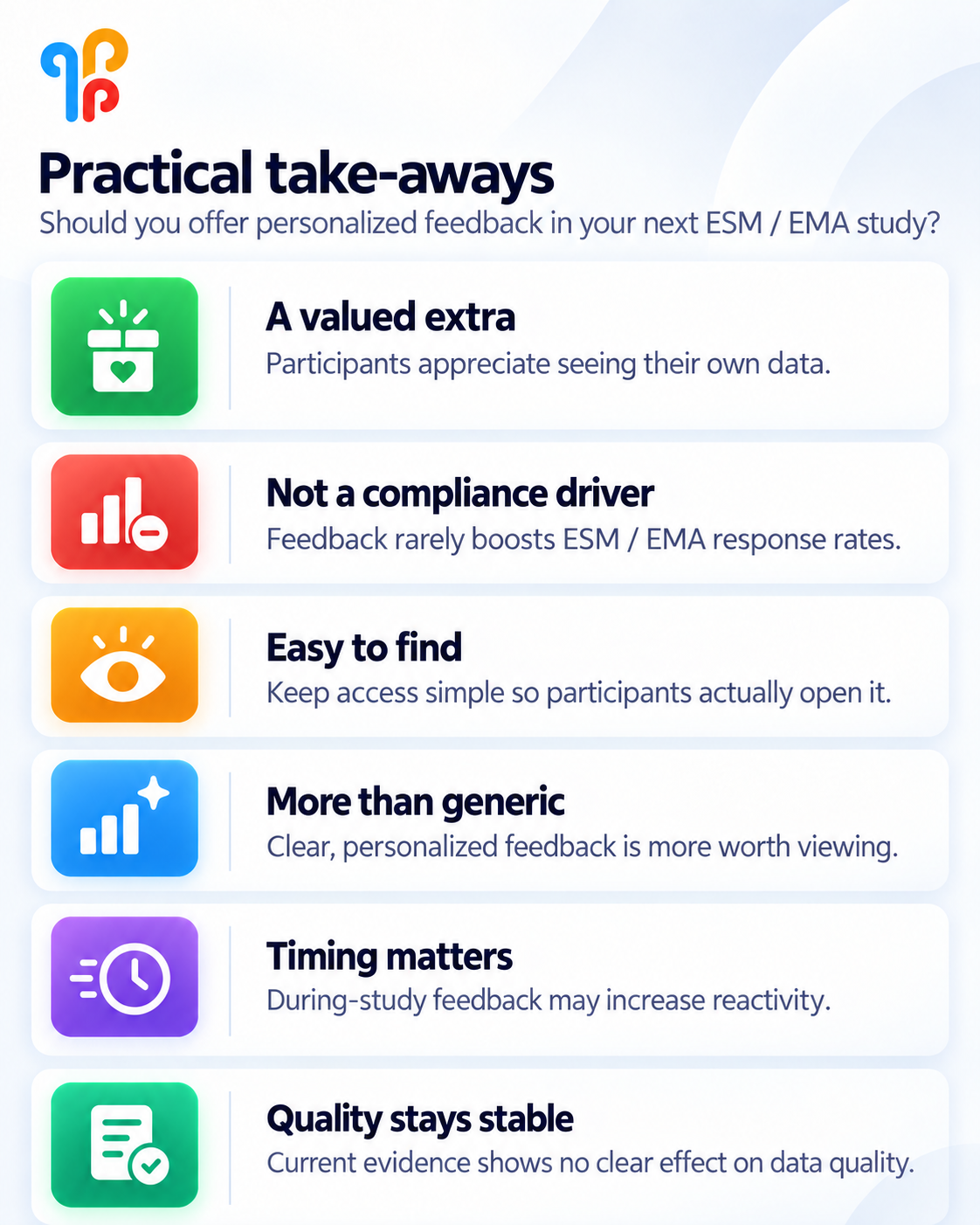
Practical take-aways regarding feedback in ESM / EMA.
Conclusion
Personalized feedback looks more promising as an affordable way to give something meaningful back to participants than as a stand-alone compliance strategy. The more interesting question may therefore be not whether feedback works, but which feedback, delivered when and how, participants actually engage with.
At m-Path, we take this seriously. That is why we offer several ways to provide personalized feedback, allowing researchers to experiment with which type of feedback participants find most motivating, engaging or rewarding.
Ready to make personalized feedback part of your next ESM / EMA study? Explore the different feedback options in m-Path.
👉Explore the full papers here: Behavior Research Methods, 2026; Social Science Computer Review, 2022; Children, 2023; Journal of Trial and Error, 2024; Assessment, 2023; Assessment, 2022; UbiComp Proceedings, 2008; Assessment, 2018; Computers in Human Behavior, 2024

Dr. Egon Dejonckheere is an Assistant Professor at Tilburg University, affiliated with KU Leuven, specializing in ambulatory assessment and intensive longitudinal research.
His work combines methodological innovation to improve these methods with applications in mental health and emotion dynamics, and includes dozens of smartphone-based studies in daily life.