

SEMA³ is closing and recommends m-Path as the alternative.
TL;DR
SEMA³, the free experience sampling (ESM) / ecological momentary assessment (EMA) platform developed at the University of Melbourne, is being discontinued in 2027. The SEMA³ team now recommends m-Path as the first option for researchers looking for an alternative. Given our shared background in ESM / EMA research and our extensive free tier, m-Path is very happy to help. We take that recommendation seriously and want to make the transition as smooth as possible for ongoing and upcoming studies.
For many years, SEMA³ has provided researchers with a free and accessible platform for running experience sampling method (ESM) / ecological momentary assessment (EMA) studies.
The team behind SEMA³, based at the University of Melbourne, is impressively small: SEMA³ is directed by Prof. Dr. Pete Koval, with day-to-day operations managed by Sarah O’Brien (a PhD student in the FEEL Lab), and technical development led by Rio Susanto and the Melbourne eResearch Group.
That is quite an achievement.
Running an ESM / EMA platform involves much more than keeping a website online.
- Mobile operating systems change.
- App store requirements evolve.
- Servers need maintenance.
- Security standards develop.
- New devices introduce new bugs.
- Researchers require support.
- ...
Doing all of that without structural funding eventually becomes very difficult. SEMA³ has now reached that point and will gradually phase out operations over 2027.
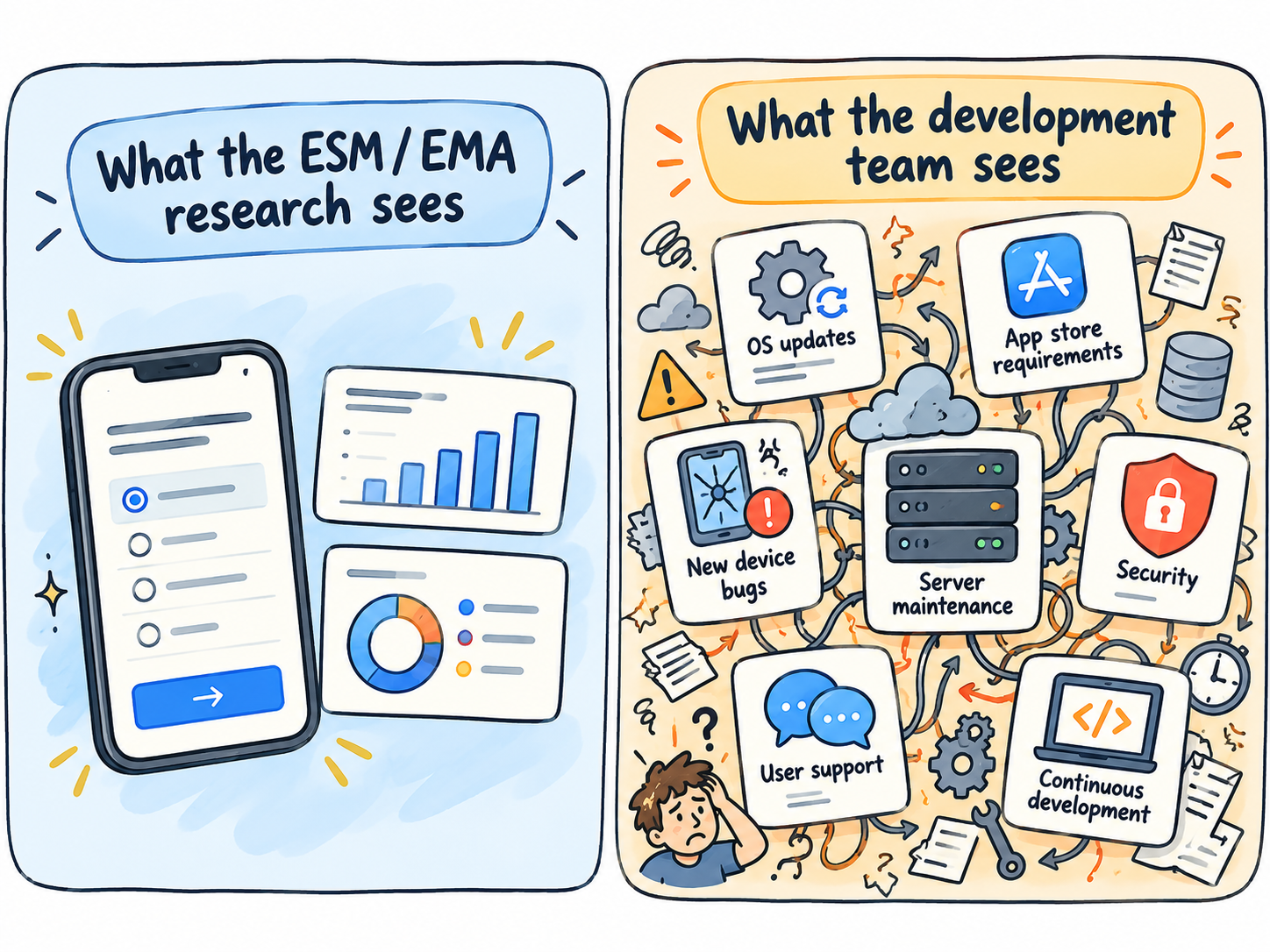
The hidden complexity of maintaining an ESM / EMA platform.
What MobileQ taught us
The story feels familiar to us.
Before m-Path, our research group at KU Leuven (Quantitative Psychology and Individual Differences) developed MobileQ, an academic platform for mobile ESM / EMA studies.
In many ways, MobileQ was a predecessor of m-Path. It helped researchers run ESM / EMA studies and grew out of the same academic motivation: researchers building the tools they needed for their own work.
But MobileQ eventually faced the same fundamental challenge.
Creating useful open-source academic software is difficult. Maintaining it year after year is even harder.
In December 2021, MobileQ stopped operating as a service.

MobileQ, m-Path's predecessor, was discontinued in 2021.
That experience strongly influenced how our team approached m-Path. We knew that building the software is only part of the challenge. Keeping it running in the long term is a different story.
We therefore wanted to preserve a substantial free offering for researchers while creating a model that could support the platform over time.
SEMA³ recommends m-Path as its preferred alternative
When a platform shuts down, the most immediate concern is the ESM / EMA research that depends on it.
Researchers may already have ESM / EMA studies running. Others may have protocols approved by their ethics committee, preregistrations written, participants scheduled, or data collection planned with SEMA³.
We are therefore very grateful that the SEMA³ team decided to recommend m-Path as the first option for researchers looking to continue their work on another platform.
There are several reasons why the fit makes sense:
- m-Path has an extensive free tier. Researchers coming from a free platform like SEMA³ can start using m-Path without immediately needing a paid license.
- Both platforms grew out of the ESM / EMA research community. Since we are researchers ourselves, we have frequently collaborated with the SEMA³ team. We share a strong understanding of the ESM / EMA literature and methodology behind these studies.
- m-Path supports both simple and advanced study designs. Researchers can recreate straightforward ESM / EMA studies, while also having access to more advanced sampling scheduling, mobile intervention and passive sensing features when needed.
- Our team can provide hands-on support during the transition. ESM / EMA studies involve more than questionnaires. Schedules, reminders, sampling windows and participant workflows all need to translate properly, and we can help when there is no obvious one-to-one solution.
We take SEMA³'s recommendation seriously
Being recommended as the first alternative by another ESM / EMA platform is something we greatly appreciate.
However, it also comes with the responsibility to translate this recommendation into concrete support for SEMA³ users.
- Financially, we want to keep the barrier as low as possible. Recent SEMA³ users can first explore m-Path through our extensive free tier. For many straightforward ESM / EMA studies, this may already provide everything they need. However, some researchers may need features that require a paid license. Because they are moving from a free platform, some may be working with limited research budgets. Active SEMA³ users will therefore receive a transition discount on a paid m-Path license. The SEMA³ team will let eligible users know how to access this offer.
- Practically, we also want to make the transition as smooth as possible. Our team can help researchers translate an existing SEMA³ setup to m-Path. If something cannot be reproduced one-to-one, we can help identify the closest alternative to preserve the original study design as closely as possible.
Of course, researchers should choose whichever platform fits their study best. We simply hope SEMA³ users will give m-Path a try, and that these measures make the transition a little easier.

m-Path welcomes previous SEMA³ users.
Same mission, new home
SEMA³, MobileQ and m-Path share a similar academic origin. All three were developed by ESM / EMA researchers who needed better tools for their own research.
We would therefore like to thank all members of the Melbourne team who contributed to SEMA³. Keeping a free research platform available for so many years takes a considerable amount of work, much of it behind the scenes.
We are grateful that the SEMA³ team has chosen m-Path as its preferred alternative, and hope we can provide a good new home for researchers who previously relied on SEMA³.
Coming from SEMA³? Contact us about your ESM / EMA study!

Dr. Egon Dejonckheere is an Assistant Professor at Tilburg University, affiliated with KU Leuven, specializing in ambulatory assessment and intensive longitudinal research.
His work combines methodological innovation to improve these methods with applications in mental health and emotion dynamics, and includes dozens of smartphone-based studies in daily life.