

How passive sensing can personalize ESM / EMA prompting.
TL;DR
Time-based experience sampling (ESM) / ecological momentary
assessment (EMA) prompts often miss short-lived moments such as craving,
stress, or pain. In this blogpost, we share the results from an internal m-Path
pilot project on nicotine craving, where we used passive wearable data to detect
when craving episodes were more likely to occur. The goal was to explore how
baseline data can make ESM / EMA sampling more context-aware and personalized.
What if the moment you most want to measure happens between two prompts? 🤔
Experience sampling (ESM) / ecological momentary assessment (EMA) helps researchers study daily life as it unfolds. But random time-based prompts cannot see what is happening in the moment. They are state blind.
For many research questions, this is fine. But for episodic states, timing matters a lot. These are states that come and go, sometimes quickly.
For short-lived states such as craving, acute stress, pain episodes, panic symptoms or conflict moments, the phone may beep after the most important moment has already passed.
This creates a clear challenge for ESM / EMA research. If the goal is to capture meaningful moments as they happen, researchers need more than a time-based schedule. They need a way to make the timing of prompts responsive to the participant’s current context.
That is where passive sensing becomes useful.
Using sensor data to inform smart ESM / EMA schedules
Wearables and smartphones can collect signals in the background, such as heart rate, heart rate variability, movement, location, phone use, sleep duration, ambient noise, and so on. These passive signals can help the system decide when a self-report may be most valuable.
In this way, these continuous data streams can be used to make ESM / EMA prompting smarter.⚡🤓
Instead of only asking at random times, the system checks when something meaningful seems to happen. For example, a wearable may detect changes in heart rate, heart rate variability, or movement. A smartphone may add contextual signals, such as location change or heavy app use.
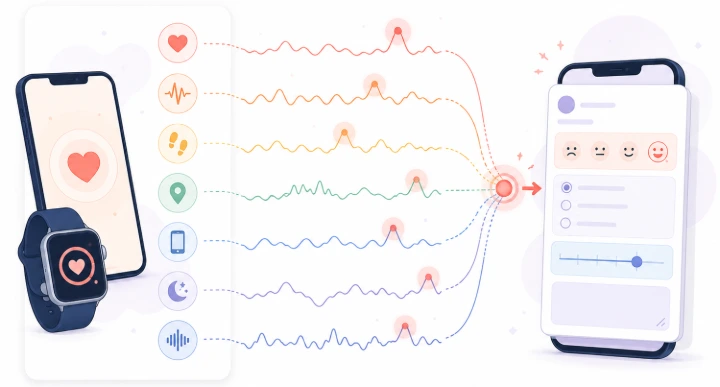
Passive sensing data from smartphones or wearables can be used to trigger context-aware ESM / EMA surveys.
But this raises a practical question:
When should the system decide to send a prompt? ⚡
A simple answer is to use a fixed rule. For example:
- send a prompt when heart rate is high (e.g., >90 bpm)
- send a prompt after a long period of inactivity (e.g., >45 minutes)
- send a prompt when phone interaction is high (e.g., >15 unlocks in the last hour)
This sounds straightforward, but it assumes that a similar cut-off is equally informative for everyone.
Research shows that this is rarely the case.
For one person, a heart rate above 100 bpm may signal a meaningful change. For another, it may simply reflect walking, cycling, or climbing stairs. A 45-minute period of inactivity may be unusual for one participant, but completely normal for someone working at a desk. And 15 phone unlocks in the last hour may indicate restlessness for one person, while being routine for another.
The core point is simple: smart ESM / EMA prompting only becomes useful when the trigger rule fits the person.
Using baseline data to inform personalized ESM / EMA prompts
Before a system can detect an unusual moment, it first needs to learn what is usual.
This is where a two-phase ESM / EMA design can be useful.
- Phase 1 helps the system learn. Participants receive standard time-based prompts. These data show what each participant’s typical patterns look like.
- Phase 2 uses that information. The system then uses what it learned to trigger more targeted ("smart") prompts.
You can think of Phase 1 as a short training period. The system learns what meaningful moments tend to look like for this participant. Phase 2 then tests whether that learned rule can catch relevant moments more efficiently.
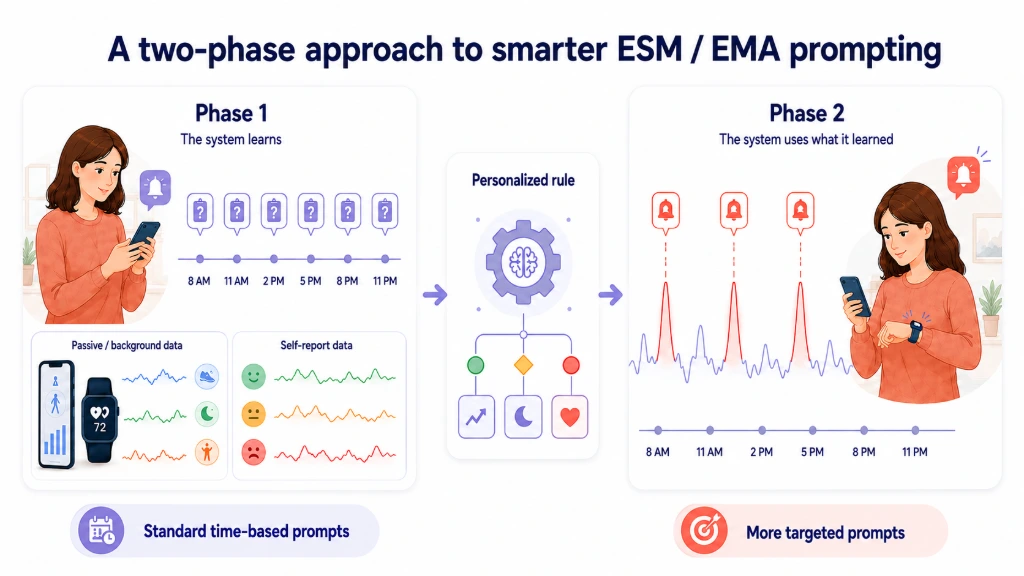
Use baseline data to inform smart and tailored ESM / EMA prompts.
It is this two-phased approach we tested in an internal m-Path pilot study on nicotine craving.
A case study: detecting episodes of nicotine craving in daily smokers
In an internal feasibility project led by Manha Zamir and María Fernanda García Verduzco, we explored whether wearable data and ESM / EMA responses collected during a baseline phase could help predict cigarette craving in daily smokers, and prompt them at exactly that moment.
Craving was a useful test case because it is short-lived, depends strongly on context, and may show up in wearable signals such as heart rate or heart rate variability. Since these patterns can differ from person to person, craving is well suited to test personalized ESM / EMA prompting.
We invited 31 daily smokers for a two-week ESM / EMA study involving wearable sensing through our Garmin Direct integration.
- Week 1 was purely observational. The goal was to learn when craving typically occurred for each participant. Participants received 12 semi-random prompts per day, asking about their momentary stress, current cigarette craving, and time since their last cigarette. At the same time, Garmin smartwatches passively collected potential physiological predictors in the background, including heart rate, heart rate variability, and Garmin’s proprietary stress score.
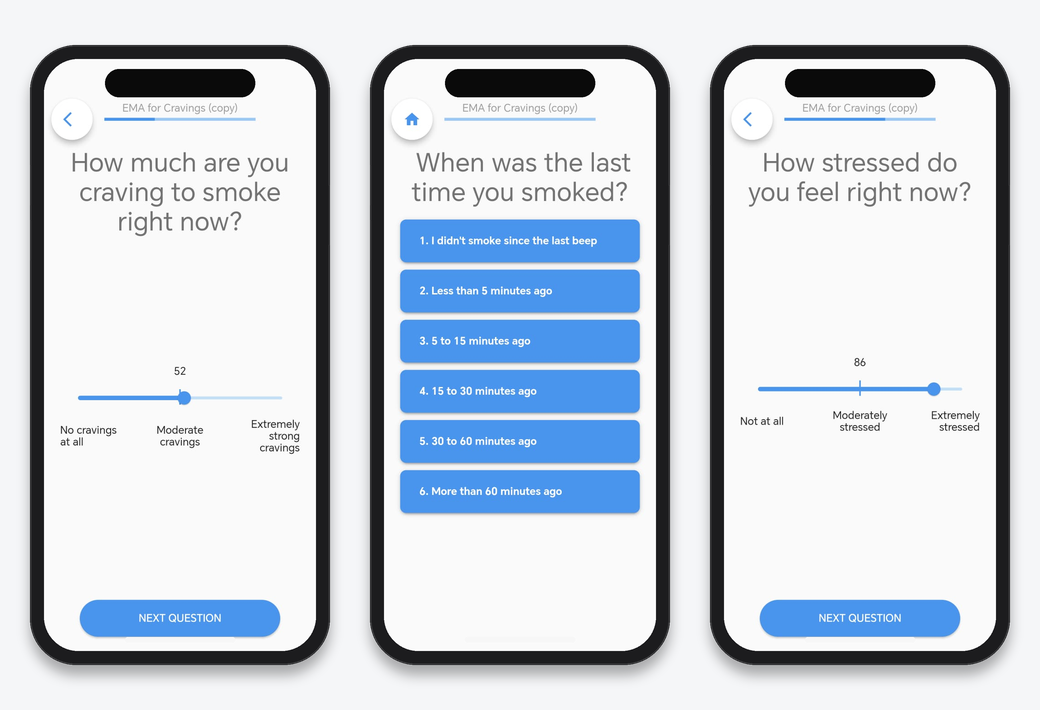
The m-Path self-report items used in our craving case study.
- We used these training data to build a personalized prediction model for each participant's craving and deployed the trigger rule through m-Path's computation item in pseudo-R.
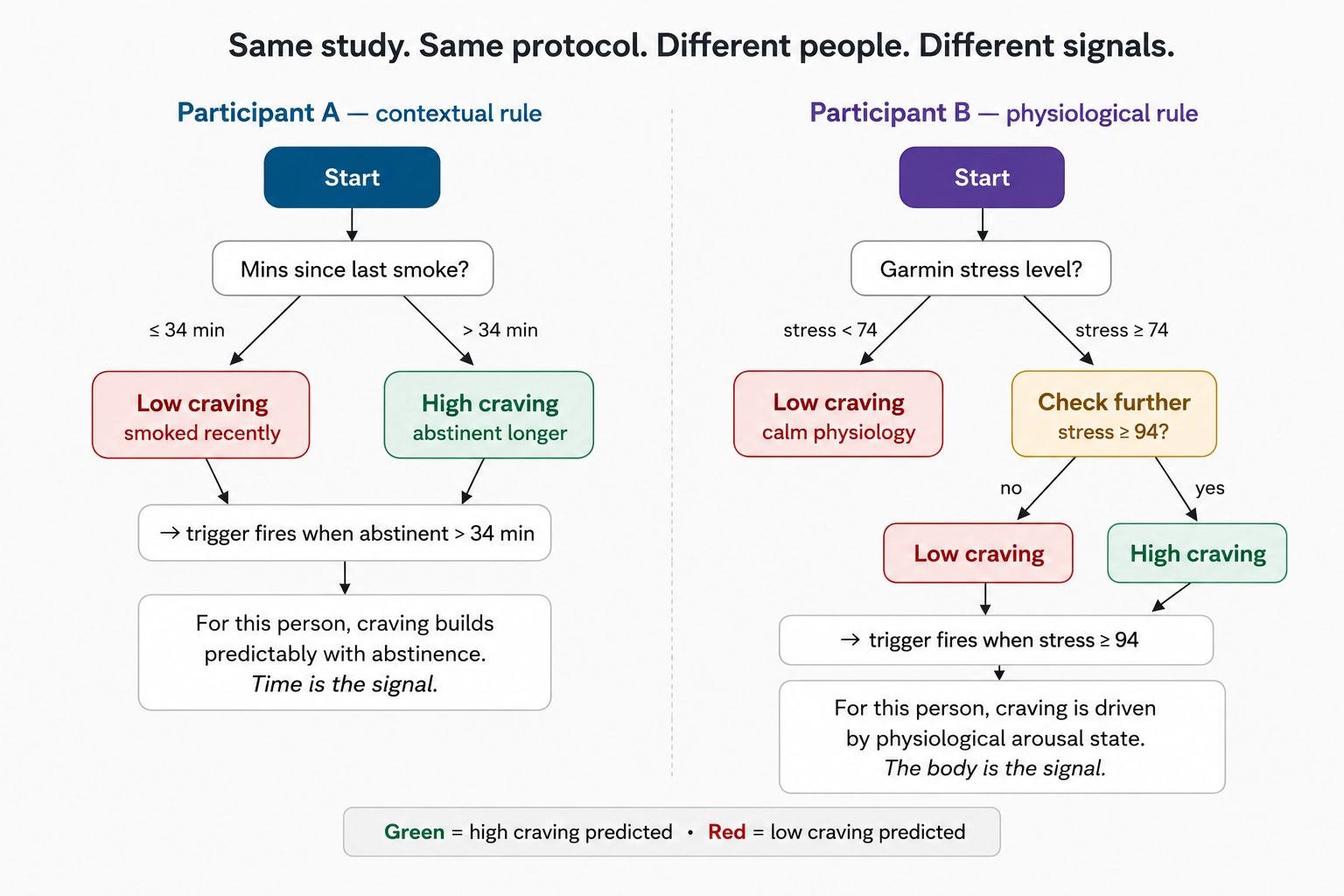
Two different craving decision threes for two different (real) participants.
- Week 2 was the evaluation phase. During this week, participants received 3 time-based prompts per day and up to 3 additional sensor-triggered ("smart") prompts. These sensor-triggered prompts were based on each participant’s individual decision tree and were delivered when the system detected conditions associated with elevated craving for that specific person.
What we found
1. Craving does not follow one universal pattern
Craving patterns varied strongly between participants.
Some participants showed clearer craving at specific times of day. Others showed more irregular temporal patterns. For some, craving increased with time since the last cigarette. For others, physiological signals seemed more relevant.
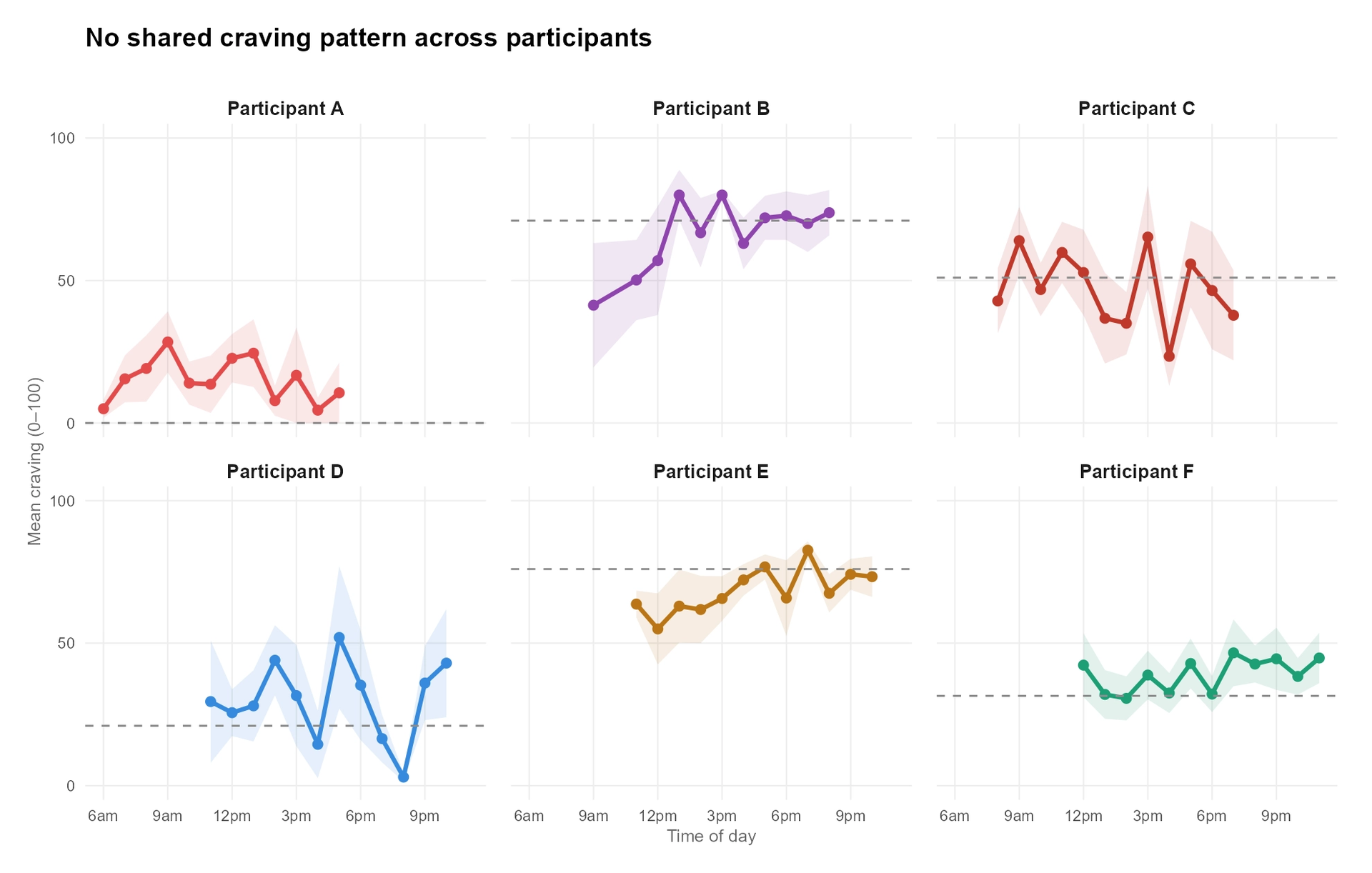 Participant’s craving patterns across an average day, illustrating that temporal dynamics in craving varied substantially between (and for some, within) participants rather than following one shared daily rhythm.
This matters because it supports the idea of collecting baseline ESM / EMA data in Phase 1 to specify a personal decision rule. A fixed trigger rule calibrated to the group would have missed most individual peaks.
2. Craving signatures were highly individual.
For many participants, the strongest predictor was time since the last cigarette, a contextual predictor. That makes sense. As more time passes after smoking, craving can gradually increase.
For others, wearable signals played a larger role, suggesting physiological indicators gave stronger clues about upcoming craving.
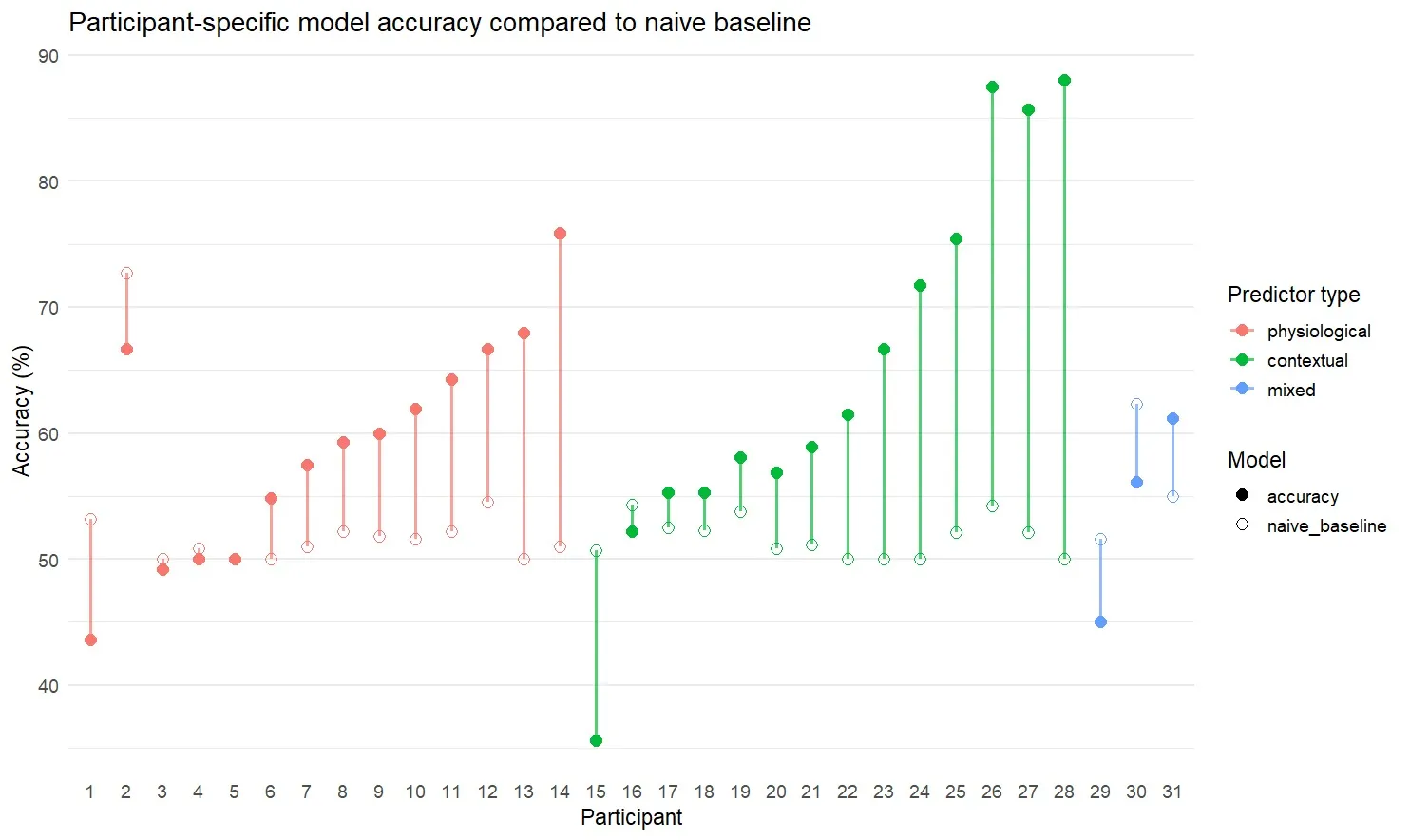
The naive baseline is about 50% accuracy for most participants because craving labels were split at each person's median score. A model that cannot perform better than this is no better than chance.
For some participants, the available predictors did not produce a reliable rule.
That does not mean their craving was random. It probably means that we did not measure the right context yet. Craving may depend on location, social situations, routines, alcohol use, work breaks, or other unassessed smoking cues.
For feasibility purposes, our current predictor set was quite limited.
3. The system worked, but prediction needs more work.
The technical pipeline worked in daily life.
Garmin data came in, m-Path applied the decision trees, and sensor-triggered ESM / EMA prompts were delivered during the evaluation week.
Participants also responded well. Response rates were slightly higher for sensor-triggered prompts than for time-based prompts (78% vs 75%).
That is encouraging, because context-aware prompts only help if people actually answer them.
However, the more cautious finding was that sensor-triggered prompts did not clearly capture higher-craving moments than regular time-based prompts.
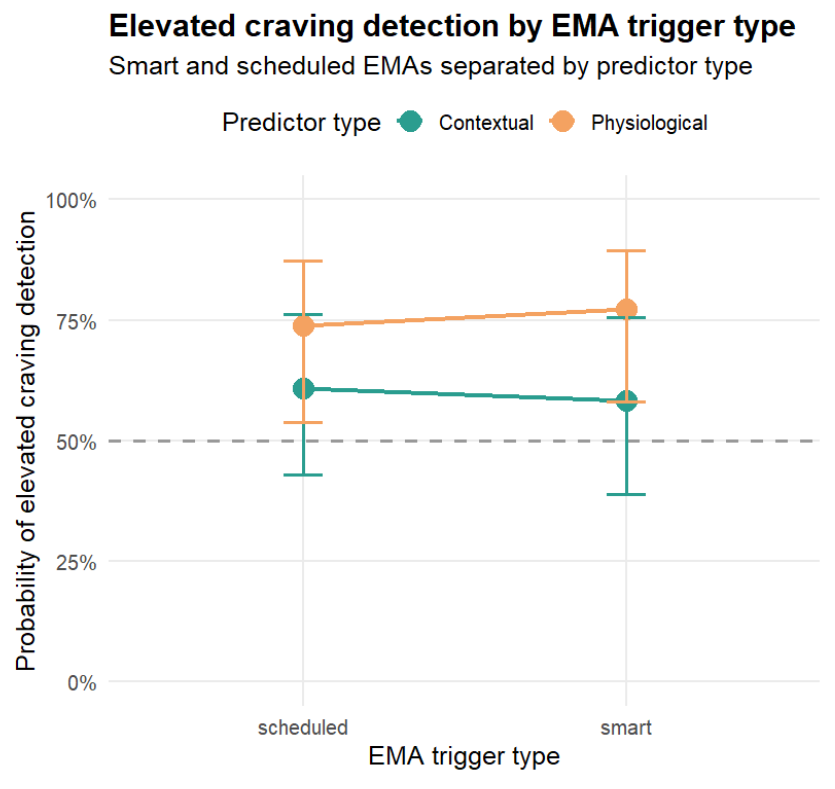
Sensor-triggered ESM / EMA prompts did not clearly detect elevated craving more often than scheduled prompts.
In other words, the system was context-aware in design, but not yet more context-sensitive in practice. Improving the predictive accuracy of context-aware prompts likely requires richer (sensor) data and longer calibration periods.
Some considerations when designing smart ESM / EMA sampling schemes
Below are some of the key lessons we learned while designing and implementing this project.
1. Reducing burden also reduces what the model can learn
One promise of smart prompting is that it can reduce unnecessary ESM / EMA prompts.
But fewer prompts also mean fewer self-reports. That makes it harder for the system to learn.
That matters when the model depends on self-reported information. In this study, time since last cigarette was calculated from participants’ answers. If prompts become too sparse, this variable becomes less precise.
So researchers need to balance two goals: reduce burden and keep enough (self-report) data to learn from.
2. Use enough predictors and enough calibration data
Smart prompting depends on what the system can learn.
That means two things matter: the predictor set should be rich enough, and the calibration period should be long enough.
If you only measure a few signals, you may miss the cues that actually matter.
The same applies to time. Some patterns may not become visible after only a few days of baseline data.
So a key lesson is: make the predictor set as broad as is practically and ethically possible, and give the system enough time to learn stable patterns.
3. The burden paradox: ask enough, but not too much
At the same time, if the goal of smart sampling is to reduce burden by asking fewer unnecessary questions, a lengthy calibration period may undermine its original purpose.
That creates a burden paradox. A more intensive baseline may make later prompts smarter, but it also asks more from participants upfront.
One solution is to avoid starting from zero.
For example, the system could begin with the global assumption that craving often increases with time since the last cigarette. It could then learn whether that rule holds for this participant.
This gives the model a useful starting point, while still allowing individual differences to emerge. General population-based info may shorten the calibration period.
4. Wearable coverage is part of the model
Smart prompting only works when sensor data are available, and the personalized prediction model is only as strong as its sensing coverage.
If the sensing app goes in deep sleep mode, or the watch is not worn, not charged, or not syncing, the trigger rule cannot fire. In our study, missed craving moments sometimes coincided with missing sensor data rather than poor model performance.
Treat wearable compliance as a core part of the study design, not as a technical side issue. Invest in clear instructions, reminders, and monitoring from day one.
5. Fewer prompts do not always feel lighter
Reducing the number of ESM / EMA prompts through sensor-based triggering sounds like a clear burden reduction.
But frequency is only one part of burden.
In our study, participants received fewer prompts in Week 2, but they reported that smart triggers were less predictable than the (semi-random) Week 1 rhythm.
That unpredictability may make prompts feel more intrusive, even when there are fewer of them. Reducing prompt frequency is not the same as reducing participant burden when (semi-)routine is replaced by uncertainty.
Final take-away
Our nicotine craving study shows both the promise and the challenge.
Personalized smart prompts are technically feasible, and participants responded well to them.
But accurate prediction requires enough baseline data, a rich enough predictor set, good wearable compliance, and careful attention to how unpredictable prompts feel for participants.
So the next question for researchers is not only:
What do we want to measure?
But also:
When is the best moment to measure it?
That is where passive sensing can make ESM / EMA research more personal, more context-aware, and potentially more informative.
Check out our dedicated manual page on setting up wearable triggering in your ESM / EMA study using our Garmin Direct Integration.