

How to study shared events in dyadic daily life research.
TL;DR
In dyadic daily life research, partners often report on “the same day” but not necessarily on the same event. A daily diary study by Carlier and colleagues tested a new m-Path open-question workflow in 107 romantic couples. One partner briefly described a shared negative event, and that description was automatically shown to the other partner. The result? High couple-wise compliance, 97% event recognition, and rich data on how both partners experienced the same situation.
Imagine asking both partners in a couple:
“How negative was your interaction today?” on a 0-100 slider scale.
One partner thinks about a tense dinner conversation. The other thinks about a stressful phone call with the landlord that happened while they were both present.
Both answers may be valid. But are they answers to the same question? 🤔
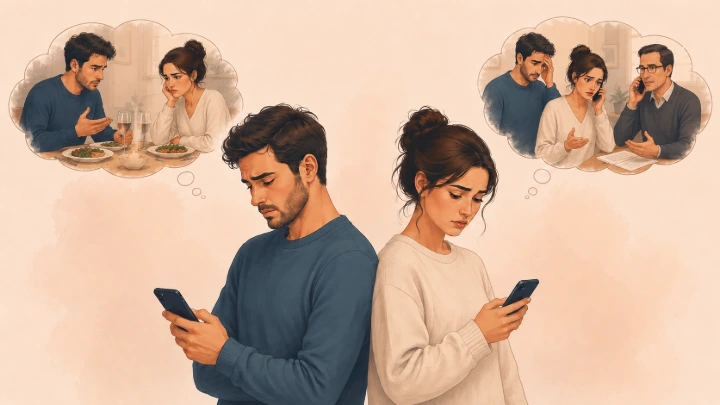
Partners do not always refer to the same event when completing a momentary survey.
The problem: same same, but different
Event ambiguity is a common challenge in dyadic daily life research. Whether it's an experience sampling (ESM) / ecological momentary assessment (EMA) or daily diary study, partners may receive the same survey at the same time, and both may report that “something negative happened.”
Still, we cannot always be sure they are referring to the same event.
That matters. If we want to study emotional similarity, emotion (co-)regulation, support, or conflict escalation, the event is the context that gives the emotions meaning.
In this way, event ambiguity can make partners look less emotionally similar than they really are. Or it can create apparent disagreement where the real issue is simply that the survey did not anchor both people to the same event.
That can blur the signal of the daily life data you collect.
The solution: let one partner describe the event
To resolve this event ambiguity, m-Path developed a new, straightforward open-question workflow:
One partner receives a momentary prompt in the m-Path app. This partner is asked to describe the most negative event since the previous prompt in which the other partner was also involved or present. The description should be concise, objective, and recognizable for the partner.
After the first partner completed the momentary prompt, the second partner automatically receives the event description on their phone, and answers questions about that same event.
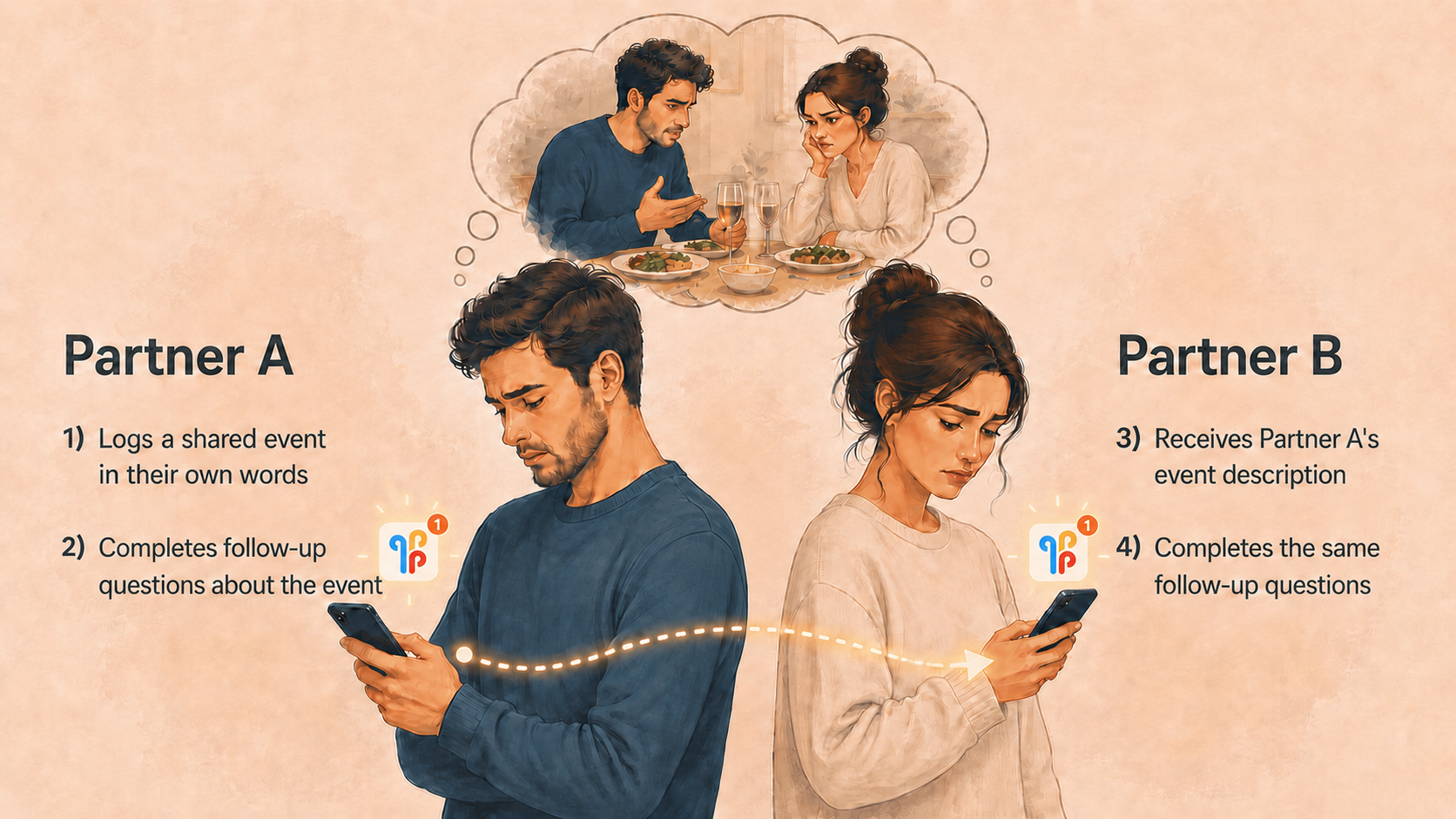
Piping text across devices to ensure same-event reports in dyadic research.
So instead of asking both people to independently reconstruct the assessed time period, the workflow creates a shared anchor:
“This is the event we are both rating.”
This small design change has large methodological consequences. It turns dyadic diary data from parallel individual reports into linked reports about a shared event.
The study at a glance
In a recent study, Chiara Carlier and colleagues explored the effectiveness and feasibility of this workflow in a three-week dyadic daily diary study.
The study included 107 romantic couples. Every evening, one partner was randomly assigned as the sender and described the most negative shared event of the day. The other partner then received that description and responded as the receiver.
The sender and receiver roles switched repeatedly across the 21 days. This is important because the study later showed that senders tended to rate their chosen events as more negative than receivers did.
Each partner answered short questions about the event, including how negative it felt and whether they had discussed it. Receivers also indicated whether they recognized the event described by their partner.
What they found
1. The same-event reports were feasible.
The study found high couple-wise compliance. On average, both partners completed the diary on 89% of study days.
That is important because dyadic diary designs are demanding. The design requires not just one person to respond, but both partners to complete linked surveys on the same measurement occasion.
2. Event descriptions were highly recognizable by the other partner.
The event descriptions were also short. On average, partners used about 20 words to describe the event. Yet those short descriptions were enough: receivers recognized 97% of the events described by their partner.
3. Senders experienced the events as more negative than receivers.
The chosen events were moderately negative overall. But senders rated them as more intense than receivers: 41.10 versus 32.98 out of 100.
That is important because the partner who selects the event is likely choosing something that stood out to them. The other partner may recognize the same event, but experience it as less emotionally intense.
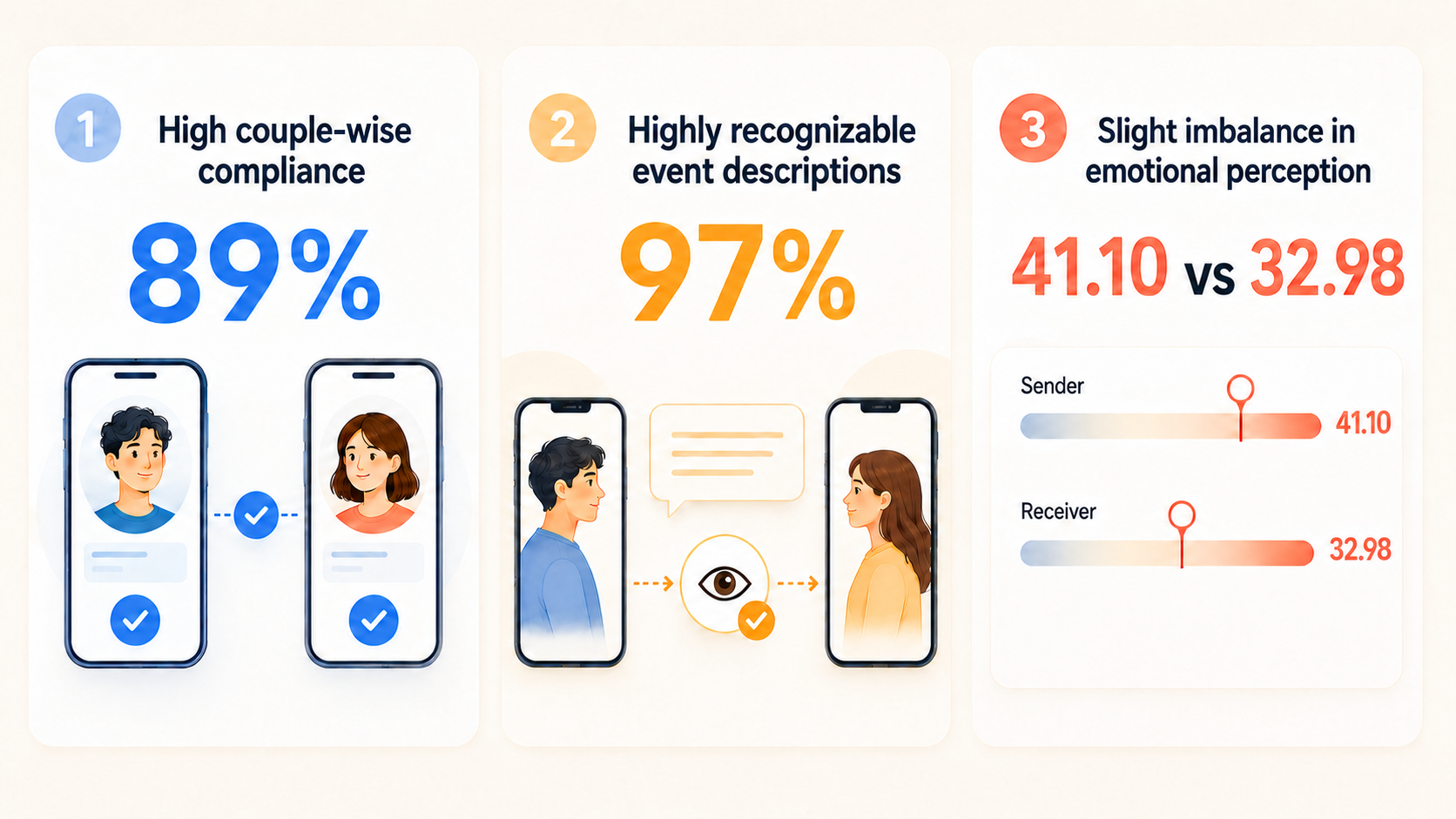
Shared-event reports are feasible, highly recognizable and produce rich emotional data.
What researchers can study with this shared-event design
This shared open-question workflow is especially useful when your research question depends on both people responding to the same interpersonal event.
It could be used to study:
- Emotional similarity, such as whether both partners feel similarly in response to the same shared event.
- Conflict dynamics, such as whether both partners escalate or one partner down-regulates.
- Emotional support, such as whether one partner intended to help and the other experienced it as helpful.
- Empathic accuracy, such as whether one partner correctly understands the other’s feelings.
- Emotional co-regulation, such as whether one partner’s response helps the other recover, calm down, or reappraise the situation.
- Perspective-taking, such as whether partners attach the same meaning to a shared event or interpret it differently.
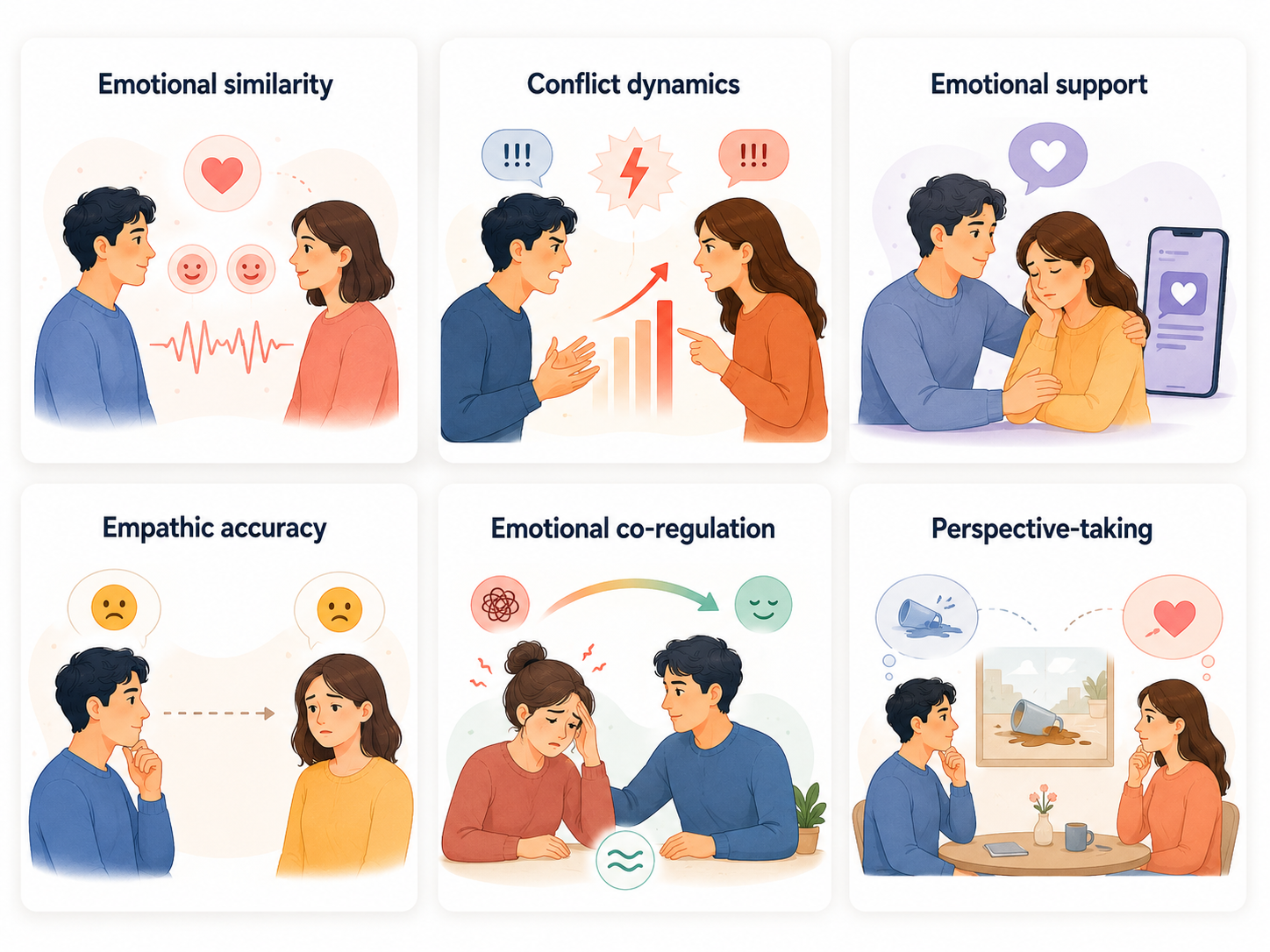
Different domains in psychological research require same-event reports.
The design can also be adapted. Instead of asking for the most negative event, researchers could ask for the most positive event, the most salient interaction, the most stressful shared event, or the last meaningful interaction.
It can be useful in a wide range of interpersonal contexts, including couple dynamics, family interactions, parent-child relations, and therapy processes.
The central principle stays the same: one participant identifies the event, and the other participant responds to that same event.
Final take-away
Dyadic daily life research often assumes that partners are reporting on the same reality. This study shows a practical way to make that assumption more defensible.
A short open-ended event description can help both partners focus on the same shared daily event. It can preserve ecological validity while improving interpretability. And it can do so without adding much participant burden.
For researchers designing dyadic ESM / EMA studies, this raises a useful design question:
Do you only need parallel reports from both partners, or do you need linked reports about the same event?
If the second is true, this open-question design offers a clear and feasible path forward.
Check out our dedicated manual page on sharing data between participant to learn how to implement the same-event reports in your dyadic research.
👉 Explore the full paper here: Personal Relationships, 2026.

Dr. Egon Dejonckheere is an Assistant Professor at Tilburg University, affiliated with KU Leuven, specializing in ambulatory assessment and intensive longitudinal research.
His work combines methodological innovation to improve these methods with applications in mental health and emotion dynamics, and includes dozens of smartphone-based studies in daily life.